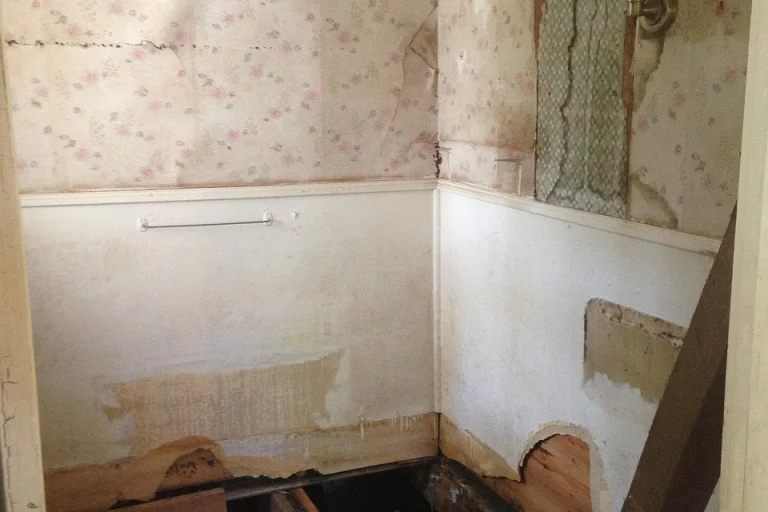
Published estimates put a typical foundation repair at about $2,200 to $8,200, with averages near $5,200 (This Old House, updated October 2026, from Angi data; Fixr, January 2026). Those averages mix small crack repairs with pier jobs. Both sources price piers at $1,000 to $3,000 each, so a job with 8 piers comes to $8,000 to $24,000 before any other work. The checker on this page turns your quote into a price per pier, shows how little of that price a crew’s wages explain, and lines up two quotes on the same basis. Our foundation and crawl space hub covers the related jobs.
One thing comes before any price. A crack on its own does not tell you the cause, and the people quoting the repair are also selling it. Guidelines from the Texas Section of the American Society of Civil Engineers say “the majority of cracks do not compromise structural integrity”. Get an assessment from a licensed engineer who is not selling the repair before you compare quotes. The section below on independent assessments explains what that should include.
Published estimates side by side
We found no government or industry survey of what homeowners pay for foundation repair. What exists are commercial cost guides and repair companies’ own price pages. Here are the headline figures, each with its date and what it says it measures. They are published estimates, not quotes, and we have not averaged them into one number.
| Source | Typical range | Average | Date | What it measures |
|---|---|---|---|---|
| This Old House | $2,224 to $8,134 | $5,179 | Updated 8 October 2026 | Angi data unless noted, plus the writers’ own 2026 research on homes of 1,000 to 2,000 sq ft in several states. Angi is a marketplace that connects homeowners with contractors |
| Fixr | $2,200 to $8,200 | $5,200 | Updated 27 January 2026 | Says it draws on pricing databases, licensed contractors and industry experts. No sample size given |
| Bob Vila | $2,176 to $7,833 | $5,001 | Updated 29 May 2024 | Quotes Angi. Its FAQ gives a slightly different range on the same page |
| Inch Calculator | $2,500 to $7,000 | $5,000 | Last updated 6 August 2023, though the title says 2026 | Says it is based on average industry costs, with no data named |
The four agree closely, and that is less reassuring than it looks. Two of them draw on Angi, and none says how many jobs it counted or what a “typical” job was. The guides do agree on one thing: the price depends on what is wrong, so the more useful figures are the ones by repair type.
Cost by type of repair
These are the same commercial guides, broken down by method. A dash means the source gives no figure.
| Repair | This Old House (Oct 2026) | Fixr (Jan 2026) | Other published figures |
|---|---|---|---|
| Crack sealing or injection | $250 to $800 | $200 to $1,000 | Inch Calculator: minor cracks usually under $2,000 (2023) |
| Piers or underpinning, each | $1,000 to $3,000 | $1,000 to $3,000, by pier type | Bob Vila, citing Angi: $1,000 to $3,000 per pier (2024). Inch Calculator: “piers and beams” about $1,000 to $1,500 each (2023). One Indiana-based repair company, for its helical piers: $1,750 to $2,200 machine-dug, $1,900 to $2,700 hand-dug, about $25 a foot beyond its standard 21 ft pier (its own prices, December 2019) |
| Whole underpinning project | – | $10,000 to $40,000 | – |
| Mudjacking or slabjacking | $550 to $1,300 | $500 to $1,900 | Inch Calculator: $3 to $8 per sq ft (2023) |
| Helical tiebacks for walls | – | $1,500 to $2,000 each; $5,000 to $15,000 a project | – |
| Bowed wall stabilization | – | $4,000 to $15,000 | Inch Calculator: $5,000 to $7,000 (2023) |
| Carbon fiber or steel strips | $4,000 to $12,000 for 12 strips | $4,000 to $12,000 | – |
| Lifting and leveling a house | $20,000 to $23,000 | $20,000 to $30,000 | – |
| Structural engineer’s report | $500 to $1,000 | $300 to $2,000 | Inch Calculator: $200 to $400 for an engineer’s opinion (2023) |
| Soil (geotechnical) report | $500 to $3,000 | $1,000 to $5,000 | – |
| Permit | $75 to $150 | $75 to $150 | – |
| Labor | About $200 an hour | Up to about $200 an hour | – |
The two main guides give the same permit range, the same per-pier range and nearly the same labor rate, and Bob Vila gave the same per-pier range from Angi in 2024. That may mean the figures came from the same place, so treat them as one view, not two independent checks. Neither says whether the $200 an hour is one worker or a whole crew.
Why the figures differ from your quote
A real quote can be several times the headline average without anyone overcharging, because the average blends very different jobs. Here is what moves the number.
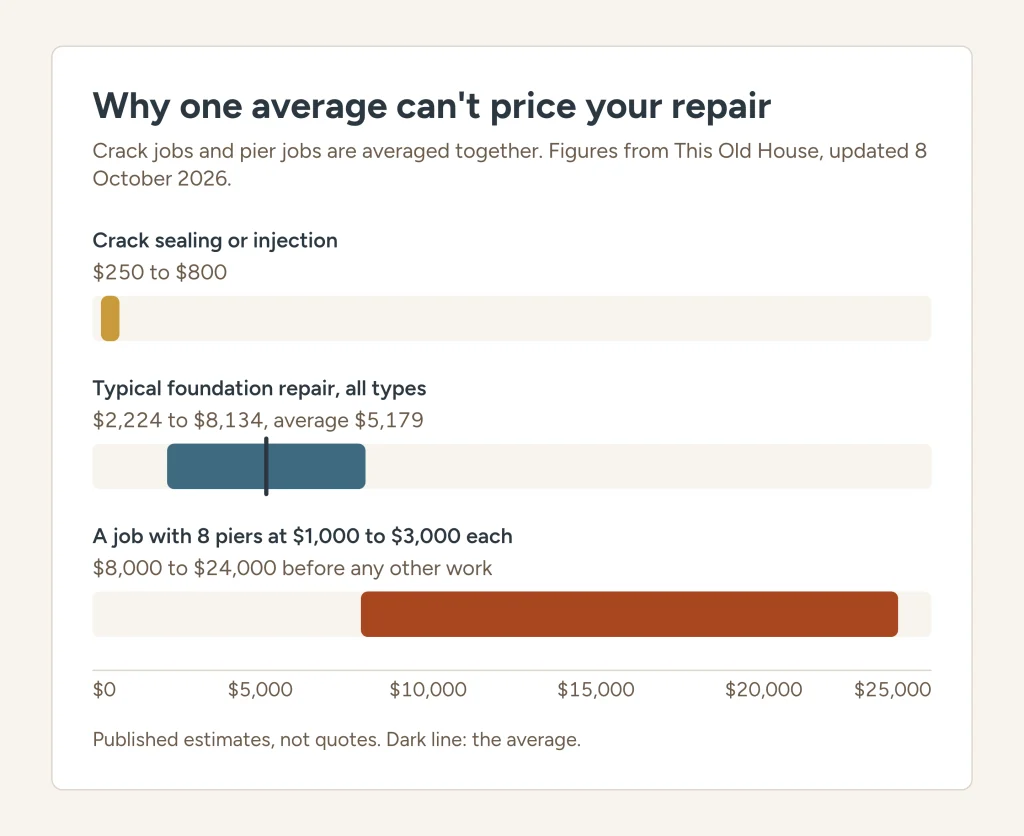
- Crack jobs and pier jobs are averaged together. A $250 crack repair and a $24,000 underpinning job both count toward a figure near $5,000. If your quote has piers, compare it per pier, not with the average.
- Number of piers. On a pier job this is the biggest multiplier. The repair company in the table spaces piers every 5 to 7 feet across the affected area, so 40 feet of wall takes roughly 6 to 8. The count should come from an engineer’s plan, not from a sales visit.
- Depth. How deep a pier goes depends on the soil, and the engineer’s plan should give it. The same repair company charges about $25 a foot beyond its standard 21 ft pier. Ask what depth your price includes.
- Access. Hand-dug piers cost more than machine-dug ones on that same page. Piers inside the house, under a patio or beside a deck add breaking and replacing concrete.
- What else is in the quote. An engineer’s letter, the permit, a plumbing test after lifting, drainage work, landscaping and concrete repair are sometimes listed and sometimes left out. Check the scope before you compare totals.
- Soil and region. Clay soils that shrink and swell move foundations, and they are common in some regions. The ASCE Texas guidelines start from the fact that the state “has large areas with clayey soils that shrink and swell.” Federal soil surveys rate this as shrink-swell potential. Above a linear extensibility of 3 percent, the USDA Natural Resources Conservation Service says in a 2008 technical guide for California soils, shrinking and swelling “can cause damage to buildings.” You can look up the soil under your house in the free Web Soil Survey.
- Age of the figure. Inch Calculator’s page was last updated in 2023 and the repair company’s prices are from 2019. Neither has been adjusted for later price changes.

What a pier price is made of
We build every CostPlain estimate from public wages and dated prices, as set out in how we estimate costs. For foundation piers that only goes so far. The pier makers’ product pages we found list specifications for brackets and tubes but no prices, and we found no public bid with a price per residential pier. So the build-up below covers the crew’s labor and shows what is left over. It does not claim to price the steel.
Labor per pier. The median hourly wage for construction laborers was $22.66 in May 2025 (BLS). That is a wage, not a contractor’s charge. In June 2026 construction employers paid on average $51.96 an hour in total compensation for every $36.13 in wages (BLS), so we multiply the wage by 1.44 to cover benefits and payroll taxes. For hours, our assumption is a three-person crew setting 8 piers in two 8-hour days: 48 crew hours, or 6 per pier. That is a round planning figure, not a measured one, and the checker lets you change it.
| Line | Working | Per pier |
|---|---|---|
| Crew cost per hour | $22.66 × 1.44 | $32.63 |
| Crew labor | 6 hours × $32.63 | $195.78 |
| Left from a $1,500 pier after crew labor (the checker’s figure) | $1,500 − $195.78 | $1,304.22 |
| Crew labor with 20% overhead and profit | $195.78 × 1.20 | $234.94 |
| Left after that | $1,500 − $234.94 | $1,265.06 |
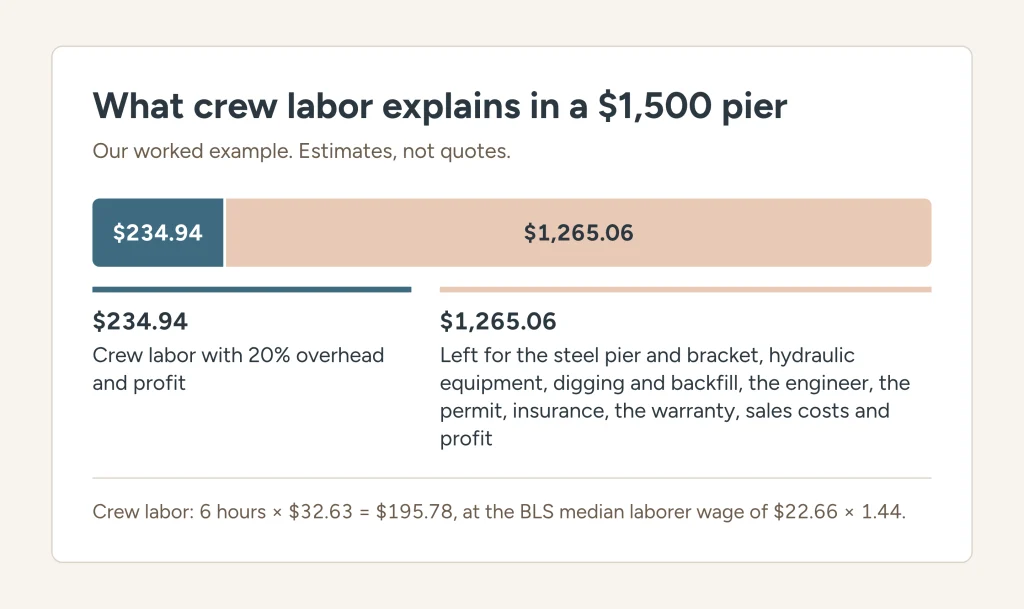
Even with overhead and profit added, crew labor explains about $235 of a $1,500 pier. The other $1,265 or so pays for the steel pier and bracket, hydraulic equipment, digging and backfill, the engineer, the permit, insurance, the warranty, sales costs and profit. The overhead and profit line is 20%, our assumption. It follows FEMA’s flood insurance program, which in a 2013 bulletin to claims adjusters calls 10% overhead plus 10% profit “the typical charge”. Real quotes vary.
That split is the point. On these numbers, paying a crew less would not move a pier price much. Two quotes that are far apart per pier are more likely to differ in the steel system, the depth, the warranty or the margin. Ask which.
A crack injection, built up in full. Here the material does have a public price. A crack-repair kit with two 10 oz cartridges of injection epoxy, sealer paste and seven ports was listed at $135.00 on the maker’s site on 3 November 2026. The maker says it holds enough to repair an average crack 1/16 inch wide and eight feet long. A contractor would buy in bulk, so this is a price marker, not what they pay. For labor we use the BLS median for cement masons and concrete finishers, $27.41 an hour in May 2025, and our assumption of 4 hours for travel, surface preparation, setting the ports, injecting and cleanup.
| Line | Working | Amount |
|---|---|---|
| Material | One kit | $135.00 |
| Labor | 4 hours × $27.41 × 1.44 | $157.88 |
| Subtotal | $292.88 | |
| Overhead and profit, 20% | $292.88 × 0.20 | $58.58 |
| Estimate for one 8 ft crack | $351.46 |
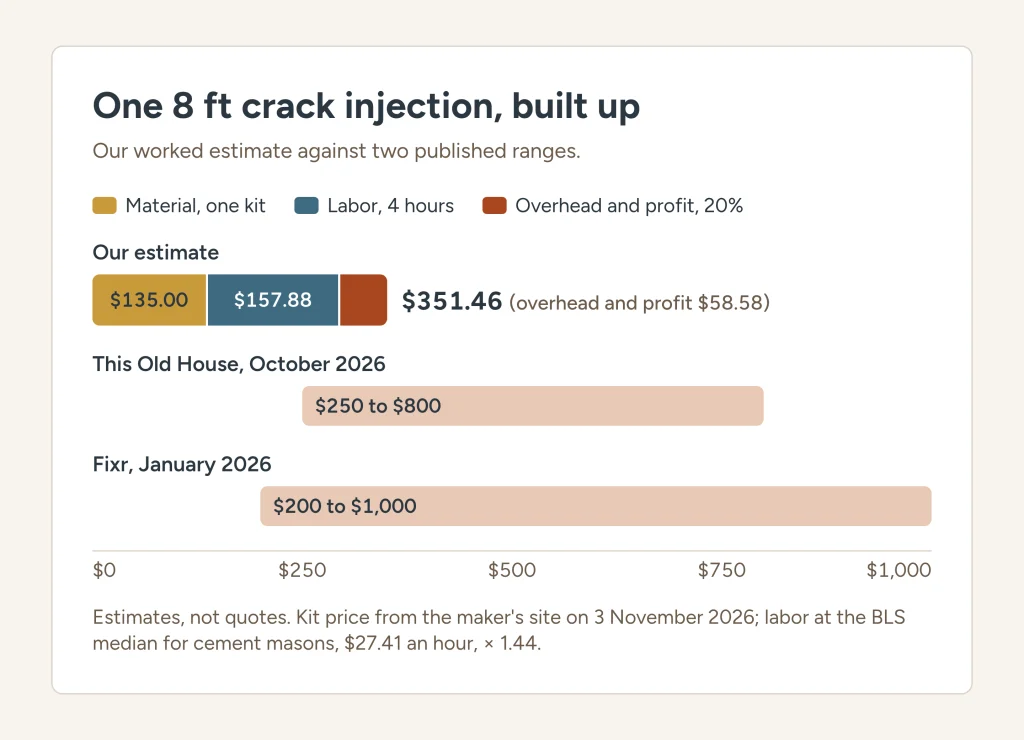
That sits inside This Old House’s $250 to $800 and Fixr’s $200 to $1,000. A crack quote well above those ranges should say why: more than one crack, a longer one, or other work such as drainage.
How the quote checker works
The checker does arithmetic on your own quote. It cannot tell you whether a repair is needed or whether a price is reasonable for your house. It shows the price per pier, how much of it crew labor explains, where it sits against the $1,000 to $3,000 published range, and how two quotes compare. Every formula is below.
- Price per pier = (quote total − items that are not piers) ÷ number of piers
- Crew labor per pier = crew hours per pier × wage × 1.44
- Left per pier = price per pier − crew labor per pier
- Crew labor share = crew labor per pier ÷ price per pier
- Above or below the published range = how far the price per pier sits above $3,000 or below $1,000
- Quote plus independent engineer = quote total + the engineer’s fee you pay separately
- Comparison = the same price per pier for the second quote, and the gaps in price per pier, total and pier count
Worked example, the checker’s defaults. Quote A is $12,800 for 8 steel piers, with $800 of other lines (crack injection, the permit and a plumbing test). That leaves $12,000 for piers, or $1,500 a pier. Crew labor at 6 hours × $32.63 is $195.78, about 13% of the pier price, which leaves $1,304.22 a pier for everything else. $1,500 sits inside the published $1,000 to $3,000. With a $600 independent engineer’s report, the all-in cost is $13,400.
Quote B is $9,600 for 6 piers with $300 of other lines: $9,300 ÷ 6 = $1,550 a pier. B is $3,200 cheaper in total but $50 dearer per pier. The whole difference is two fewer piers. Which quote is better depends on whether your house needs 6 piers or 8, and that is a question for the engineer’s plan, not for the price.
The engineer box defaults to $600, a worked-example figure inside Fixr’s $300 to $2,000 and This Old House’s $500 to $1,000 for a report. Our guide to foundation inspection prices goes into what different inspections cost and include.
Get an independent assessment first
A repair firm’s free inspection comes from the company that will sell the repair. That is a reason to get a second view, not a reason to distrust every firm. The most detailed public guidance we found is from the Texas Section of the American Society of Civil Engineers, whose residential foundation guidelines (Version 3, adopted 2022) are written for engineers in Texas. They are voluntary, but they set out what a careful evaluation looks like anywhere:
- No conflict of interest. “It is essential to avoid conflicts of interest to maintain the credibility of the evaluation investigation.”
- Three levels of inspection. Level A is “a report of first impressions” from a walk-through. Level B adds a floor elevation survey with a scaled drawing, and reports deflection and tilt against tolerances. Level C adds tests such as soil sampling and plumbing tests. Ask which level you are paying for.
- Cracks alone are not proof. The guidelines say “the majority of cracks do not compromise structural integrity” and that some signs of movement do “not necessarily imply” a structural problem. A crack doesn’t show its own cause.
- Cheaper options are valid. The engineer “should consider the cost effectiveness and practicality” of repairs, and an owner “may choose to perform periodic cosmetic repairs and door adjustments, rather than comprehensive foundation underpinning.”
Check that the engineer is licensed with your state’s engineering board, and ask in writing whether they have any business tie to a repair company. Some cities require an engineer’s plan before a repair permit. Denton, Texas, for example, says “All foundation repairs require a permit” and asks for a repair letter and plan sealed by a Texas registered engineer. Rules differ by city and county, so ask your local building department.
What a foundation quote should list
Most of these come from the documents the ASCE Texas guidelines expect an engineer’s repair plan to contain. A contractor’s quote that leaves them out is hard to compare with anything.
- A plan view with every pier marked, the pier type, and the “sizes, depths, material types” the design calls for.
- The depth included in the price, and the charge per foot beyond it.
- What the lift is meant to achieve. The guidelines say “It is unlikely that elevation adjustments will result in a level foundation.” Be wary of a quote that promises a level floor.
- A line saying which areas are not supported. The guidelines say the documents should state “that underpinning will not improve the performance of the foundation in non-underpinned areas.” A partial repair can be the right choice. You should know which part you are paying for.
- A plumbing test after lifting. “Water supply and sanitary drain lines should be tested for leaks if jacking or lifting is included in the remedial measures.” Ask who pays if a leak is found. A leak under a slab is its own job, covered in our slab leak repair cost guide.
- A floor elevation survey before and after, with a copy to you.
- The engineer, permit and inspections: who hires the engineer, whether the permit is included, and who arranges the final inspection.
- Site restoration: landscaping, concrete patches and interior floor work, or a clear statement that they are not included.
- The warranty in writing. Some firms advertise lifetime warranties that transfer to a new owner. That is a sales claim until you read the terms: what is covered (for example, only re-adjusting the piers, or also damage to walls and floors), who decides a claim, whether a transfer fee applies, and what happens if the company closes.
- Drainage items, priced separately if included.
Red flags in a foundation quote
- A price before anyone measures. Without at least a floor elevation survey, a pier count is a guess.
- A single lump sum. If the quote gives no pier count, you can’t check it per pier. Ask for the count and locations.
- A same-day discount. Pressure to sign today leaves no time for an independent opinion.
- Whole-house piering for one cracked wall, with no engineer’s reasoning in writing.
- No mention of water. The guidelines list gutters, downspouts and grading among the non-structural measures. They suggest ground sloping away at 5 percent, “6 inches in 10 feet,” for the first 10 feet where practicable. A quote that ignores how water reaches the foundation may be treating a symptom.
- Claims you can’t check, such as “permanent” or “guaranteed level”. Ask for them in the contract.
Repair now, or fix water and watch
The ASCE Texas guidelines say “Applying non-structural remedial measures and monitoring foundation performance prior to or in lieu of structural repairs may be a prudent approach.” Those measures are steady soil moisture around the house, dealing with trees and large shrubs near the foundation, gutters and downspouts carried “well past the edge of the foundation”, and surface grading and drains. The guidelines also warn that removing a tree can cause heave as the soil wets up again.

Watching is cheaper only if someone measures. A second floor elevation survey some months later, compared with the first, shows whether movement is continuing. The ASCE Texas guidelines describe repeated surveys over months or years for this. If the engineer finds active movement or a structural problem, waiting can add damage and cost. That call belongs to the engineer and you, not to a price table. Wet basements and drainage have their own costs: see foundation waterproofing costs and the French drain cost calculator. Pier and beam homes are repaired differently, with shims, framing repairs or added supports under the floor, according to the guidelines; our crawl space repair cost guide covers that.
This page gives prices, not repair steps. Jacking and underpinning move the structure of the house, and the guidelines note that gas service lines may need adjusting after a lift. Leave the work to a licensed contractor working to an engineer’s plan, with the permit your local building department requires.
Insurance and paying for it
Whether a homeowners policy pays for foundation repair depends on its wording and on the cause. A plumbing leak, a storm or slow soil movement can be treated differently. Read the exclusions in your own policy and ask your insurer in writing before you sign a repair contract. If you are buying or selling a house, a written engineer’s report and the repair records are worth keeping for the next buyer. This is general information, not insurance, legal or financial advice.
What the checker leaves out
- Steel and equipment prices. We found no public price for residential pier systems, so the checker shows what is left after labor and does not split it further.
- Whether the repair is needed. Only an evaluation of the house can answer that. The checker accepts whatever pier count you enter.
- Other repair types. Wall anchors, braces, carbon fiber strips and slab lifting are priced per unit or per project in the table above. The checker is built around piers. For a crack-only quote, compare it with the crack build-up above.
- Region. The wage is a national median and the published range is national. Local wages, soils and permit fees differ.
- Price changes. All figures are as read on the dates given, with no inflation added.
General information, not professional, legal or financial advice. Cost figures are published estimates and worked examples, not quotes. A licensed local contractor, an engineer and your permit office decide what your house needs. CostPlain has no crew, does no repairs, sells no leads and takes no referral fees.
Sources checked on 3 November 2026.
Formulas and sources
- Part of the quote for piers: Arithmetic on the reader's own quote, no outside figure
- Price per pier: Arithmetic on the reader's own quote, no outside figure
- Crew cost per hour with benefits and payroll taxes: BLS Employer Costs for Employee Compensation, June 2026, construction (Table 4)
- Crew labor per pier: BLS Occupational Outlook Handbook: Construction Laborers and Helpers (May 2025 wages)
- Left per pier for steel, equipment, overhead, warranty and profit: Arithmetic on the reader's own quote, no outside figure
- Crew labor as a share of the pier price: Arithmetic on the reader's own quote, no outside figure
- Amount per pier above $3,000: This Old House: Foundation Repair Cost (updated 8 Oct 2026, cites Angi data)
- Amount per pier below $1,000: This Old House: Foundation Repair Cost (updated 8 Oct 2026, cites Angi data)
- Quote plus independent engineer: Arithmetic on the reader's own quote, no outside figure
- Second quote: price per pier: Arithmetic on the reader's own quote, no outside figure
- Price per pier, first quote minus second: Arithmetic on the reader's own quote, no outside figure
- Total, first quote minus second: Arithmetic on the reader's own quote, no outside figure
- Piers, first quote minus second: Arithmetic on the reader's own quote, no outside figure
- Employer cost per dollar of wages, construction (1.44, as of 2026-11-03): BLS Employer Costs for Employee Compensation, June 2026, construction (Table 4)
- Low end of a published per-pier range (1000, as of 2026-11-03): This Old House: Foundation Repair Cost (updated 8 Oct 2026, cites Angi data)
- High end of a published per-pier range (3000, as of 2026-11-03): This Old House: Foundation Repair Cost (updated 8 Oct 2026, cites Angi data)
Sources
- This Old House: Foundation Repair Cost (updated 8 October 2026, cites Angi data)
- Fixr: How Much Does Foundation Repair Cost? (updated 27 January 2026, commercial)
- Bob Vila: How Much Does Foundation Repair Cost? (updated 29 May 2024, cites Angi)
- Inch Calculator: Cost to Repair a Foundation (last updated 6 August 2023)
- Acculevel: costs for a settling foundation (Indiana repair company's own helical pier prices, 19 December 2019)
- ASCE Texas Section: Guidelines for the Evaluation and Repair of Residential Foundations, Version 3 (adopted 2022)
- ASCE Texas Section: Residential foundations guidelines page (Version 3 adopted April 2022)
- USDA NRCS California eFOTG Section II: Engineering interpretations, linear extensibility and shrink-swell potential (May 2008)
- USDA NRCS Web Soil Survey
- BLS Occupational Outlook Handbook: Construction Laborers and Helpers (May 2025 wages)
- BLS Occupational Outlook Handbook: Cement Masons, Concrete Finishers, and Terrazzo Workers (May 2025 wages)
- BLS Employer Costs for Employee Compensation, June 2026, Table 4
- FEMA NFIP Bulletin W-13064: Allowance for Overhead and Profit (8 October 2013)
- Polygem: LCR crack repair kit (maker's listing, seen 3 November 2026)
- City of Denton, Texas: Foundation Repair permit page (read 3 November 2026)