Crawl space encapsulation usually costs $5,000 to $15,000, according to Angi’s estimate (updated 28 October 2026), which also gives a national average of $5,500. Our own build-up for a 1,500 sq ft crawl space with 3 ft walls, a 20 mil liner and a dehumidifier comes to about $6,565, or $4.38 per square foot of floor. A plain ground cover with no dehumidifier comes to about $2,470. The calculator on this page does the same arithmetic for your crawl space, and you can change any price or hour count. For drainage, foundations and other work under the house, see our foundation and crawl space guides.
The headline figures leave out electricity. A 70-pint crawl space dehumidifier running six hours a day uses about 1,520 kWh a year. At August 2026’s average US home electricity price, that’s about $277 a year. The sections below show where each number comes from, what the published ranges measure, and what to look for in a quote.
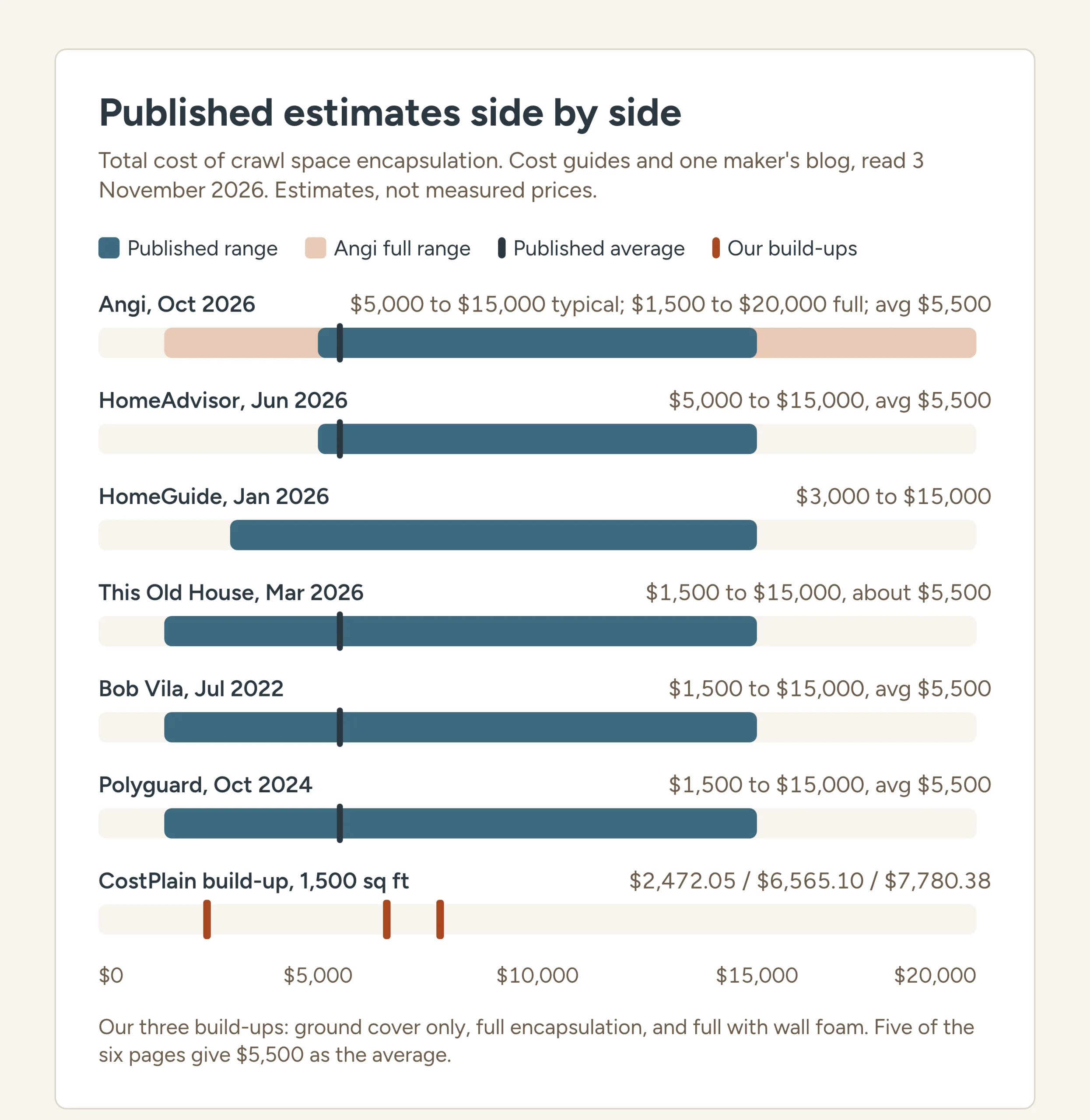
Published estimates side by side
No government agency publishes installed prices for crawl space encapsulation. The figures below come from commercial cost guides, most of which also sell contractor leads, plus one material maker. They are published estimates, not measured prices, and we have not averaged them.
| Source and date | Total | Per sq ft | What it measures |
|---|---|---|---|
| Angi, updated 28 Oct 2026 | $5,000 to $15,000 typical; $1,500 to $20,000 full range; $5,500 average | $2 to $4 basic; $3 to $10 with more work | Lead-generation site. Gives 1,000 sq ft as $2,000 to $10,000. Labor said to be 50% to 70% of the total |
| HomeAdvisor, updated 20 Jun 2026 | $5,000 to $15,000; $5,500 average | $2 to $4 basic | Same company as Angi, with the same figures. The page says it was updated using automation technology |
| HomeGuide, 14 Jan 2026 | $3,000 to $15,000 | $3 to $10 | Lead-generation site. 1,500 sq ft: $4,500 to $15,000. Vapor barrier installed $2 to $4 per sq ft |
| This Old House, updated 13 Mar 2026 | $1,500 to $15,000; about $5,500 for a complete job | $3 to $10 | Publisher with a quote form. 1,000 sq ft: $3,000 to $7,000. No method stated |
| Bob Vila, updated 20 Jul 2022 | $1,500 to $15,000; $5,500 average | $3 to $7 (its FAQ says $2 to $4) | Four years old. Lists HomeAdvisor, HomeGuide and The Spruce as sources |
| Polyguard, 17 Oct 2024 | $1,500 to $15,000; $5,500 average | Not given | Blog of a company that makes moisture, water and corrosion protection products. No method stated |
| CostPlain build-up, 3 Nov 2026 | $6,565 for our example | $4.38 | Retail prices plus BLS wages, with hours and margin as our assumptions. Shown in full below |
Notice that $5,500 shows up on five of the six pages. That doesn’t mean five sources found the same answer. Two of the pages belong to the same company, a third lists that company among its sources, and none of the pages we read explains how its average was measured. Treat it as one estimate that gets repeated a lot.
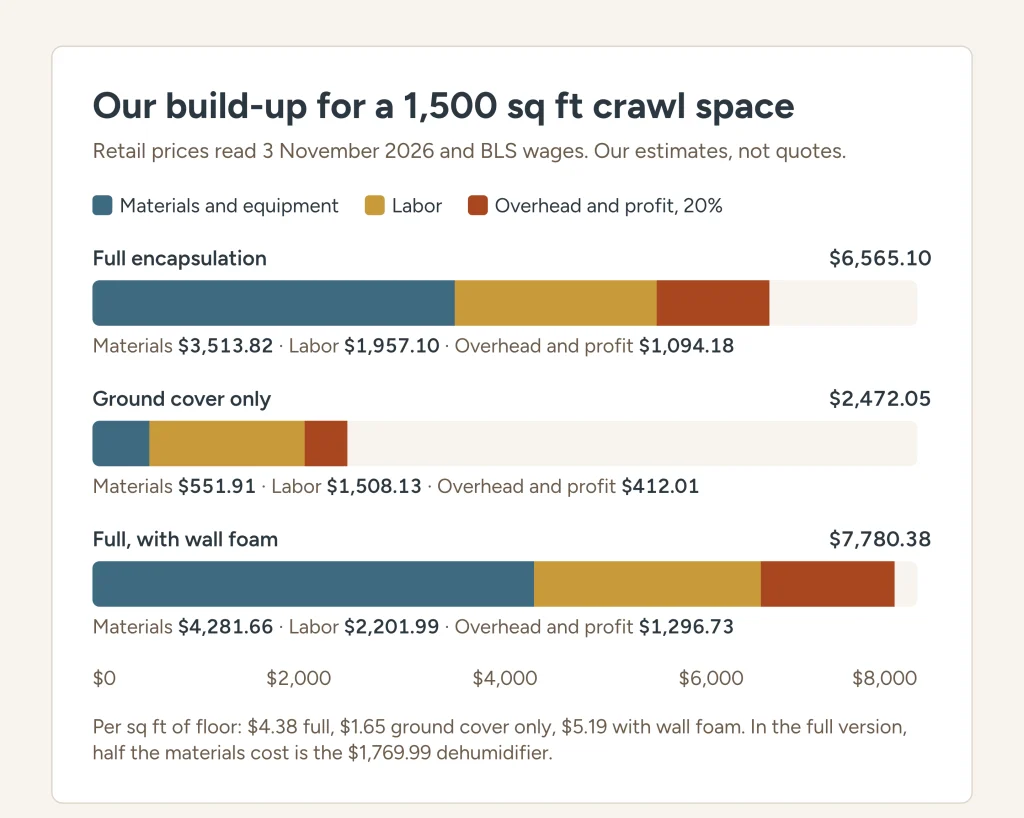
Our worked estimate for a 1,500 sq ft crawl space
The example house has a 50 by 30 ft crawl space: 1,500 sq ft of dirt floor, a 160 ft perimeter and 3 ft foundation walls. Each figure below matches a default in the calculator. Material prices are retail list prices from one crawl space supplier, Crawlspace Depot, seen on 3 November 2026. Contractors often buy for less, and prices change. Our method page explains how the build-up works.
Materials
- Area to cover: 1,500 sq ft of floor plus 160 ft × 3 ft of wall = 1,980 sq ft.
- Liner to buy: 1,980 × 1.15 = 2,277 sq ft. The 15% covers seam overlaps, piers and offcuts, and it’s our assumption. DOE’s weatherization job aid calls for seams overlapped by at least 12 inches, which on 12 ft rolls uses about 9% on its own.
- Liner: two 12 × 100 ft rolls (1,200 sq ft each) of 20 mil reinforced liner at $559.99 = $1,119.98.
- Seam tape: 1,980 ÷ 11 ft of coverage per width, plus the 160 ft wall-to-floor joint, = 340 ft. That’s two 180 ft rolls of 4-inch tape, listed from $21.99 = $43.98.
- Top edge: two 100 ft rolls of butyl tape at $39.99 = $79.98.
- Vents: 8 vents × a $28.99 cover = $231.92.
- Foam, caulk and fasteners: a $199.99 foam kit, a $47.99 case of caulk and $19.99 of fasteners = $267.97, for the rim joist, penetrations and attachment.
- Dehumidifier: one 70-pint crawl space unit, listed at $1,769.99.
Materials and equipment come to $3,513.82. Half of that is the dehumidifier.
Labor
We found no public source for how long encapsulation takes, so the hours are our assumption. We allow 2 labor hours per 100 sq ft of liner, plus 8 hours for clearing debris, raking and cleanup, and 4 hours to place and drain the dehumidifier. That’s 45.54 + 8 + 4 = 57.54 hours, or about two and a half eight-hour days for a three-person crew.
The wage is the BLS median for floor, ceiling and wall insulation workers: $49,120 a year in May 2025, which BLS’s occupational wage tables give as $23.62 an hour. That’s what workers earn, not what a firm bills. Construction employers paid $51.96 an hour in total compensation for every $36.13 in wages in June 2026 (BLS), so we multiply the wage by 1.44 to cover benefits and payroll taxes: $23.62 × 1.44 = $34.0128, about $34.01 an hour. Labor: 57.54 × $34.0128 = $1,957.10.
Overhead, profit and the total
Overhead and profit are 20%, our assumption. That covers the contractor’s office, insurance, vehicles, time spent on permits, and margin. Insurance estimates often use 10% overhead plus 10% profit, which FEMA’s flood program calls the typical charge. Real quotes vary, so you can change it in the calculator.
| Line | Full encapsulation | Ground cover only | Full, with wall foam |
|---|---|---|---|
| Materials and equipment | $3,513.82 | $551.91 | $4,281.66 |
| Labor hours | 57.54 | 44.34 | 64.74 |
| Labor | $1,957.10 | $1,508.13 | $2,201.99 |
| Overhead and profit, 20% | $1,094.18 | $412.01 | $1,296.73 |
| Estimate | $6,565.10 | $2,472.05 | $7,780.38 |
| Per sq ft of floor | $4.38 | $1.65 | $5.19 |
“Ground cover only” is a 6 mil liner at $79.99 a roll, run 6 inches up the walls with the vents left open and no dehumidifier. The seller says this liner isn’t meant for a sealed crawl space. “With wall foam” adds sixteen 48 × 94 inch EPS boards at $47.99 (480 sq ft of wall) and 7.2 more labor hours, at 1.5 hours per 100 sq ft of wall, our assumption.
To check our hours, we priced the liner work alone: liner, tapes, sealants, 53.54 hours of labor, plus 20%. That comes to $3,999.55, or $2.67 per square foot of floor. It falls inside HomeGuide’s $2 to $4 per square foot for an installed vapor barrier, so our hours look reasonable, though that’s a check, not proof.
How the calculator works
Enter your crawl space’s length, width and wall height, then tick the parts your quote includes. The formulas are:
- Area to cover = length × width + perimeter × liner height on the wall (the full wall height, or 0.5 ft for a 6-inch strip)
- Liner rolls = area × (1 + extra %) ÷ sq ft per roll, rounded up
- Tape rolls = (area ÷ 11 + perimeter) ÷ 180, rounded up. Butyl rolls = perimeter ÷ 100, rounded up
- Labor = (liner sq ft ÷ 100 × hours per 100 + prep hours + dehumidifier hours + wall foam hours) × wage × 1.44
- Estimate = (materials + labor) × (1 + overhead and profit %) + other work from your quote
- Dehumidifier electricity a year = watts ÷ 1,000 × hours a day × 365 × price per kWh
The “other work” box is for quoted items we can’t price from a tape measure: drainage, a sump pump, a new outlet, mold treatment, a permit or removing old insulation. Those items are added after overhead and profit, because a quoted price already includes the contractor’s margin.
The running cost uses 696 watts, which is 5.8 amps at 120 volts from one 70-pint unit’s spec sheet, measured at 80°F and 60% humidity. The electricity price is $0.1816 per kWh, the US residential average for August 2026 (EIA). Six hours a day is our assumption. A sealed crawl space with little moisture coming in runs the unit far less than a damp one, so a plug-in power meter for a week or two will give you your real figure.
Why the estimates differ
- “Encapsulation” isn’t one defined job. HomeGuide’s $3 to $10 is a full system, while Angi’s $2 to $4 “basic” figure matches what HomeGuide gives for an installed vapor barrier alone. Before you compare a quote with any of these numbers, find out whether it includes walls, vents, the rim joist, insulation and a dehumidifier.
- The dehumidifier is a big, separate line. At about $1,770 for the unit alone, it’s more than a quarter of our full estimate. HomeGuide prices it at $1,000 to $3,000 installed, Angi at $800 to $1,200, and This Old House at $800 to $2,000 installed with wiring. Some homes are conditioned another way and don’t need one.
- Repairs are often folded in. Angi ties its highest figures to structural repairs, pest removal and mold remediation, which can run to over $10,000. HomeGuide lists cleaning or repairs at $500 to $8,000 and drainage at $800 to $3,000.
- The labor share doesn’t match BLS wages. Angi and This Old House put labor at 50% to 70% of the job. In our build-up it’s 30%, or 36% if you count its share of overhead and profit. If labor really is half the price, either the crews take much longer than we assume, or the “labor” figure includes the firm’s overhead and margin. That gap is a good question to ask an installer.
- Material grade. A 12 × 100 ft roll at the same supplier cost $79.99 in 6 mil, $334.99 in 12 mil and $559.99 in 20 mil reinforced. That’s a $960 difference on two rolls before any markup.
- Size and shape. Wall area grows with the perimeter, not the floor area, so a long, narrow or L-shaped crawl space needs more liner per square foot of floor. Low clearance, piers and ductwork slow the crew down.
- Region and date. None of the national pages gives local figures, and Bob Vila’s is from 2022.
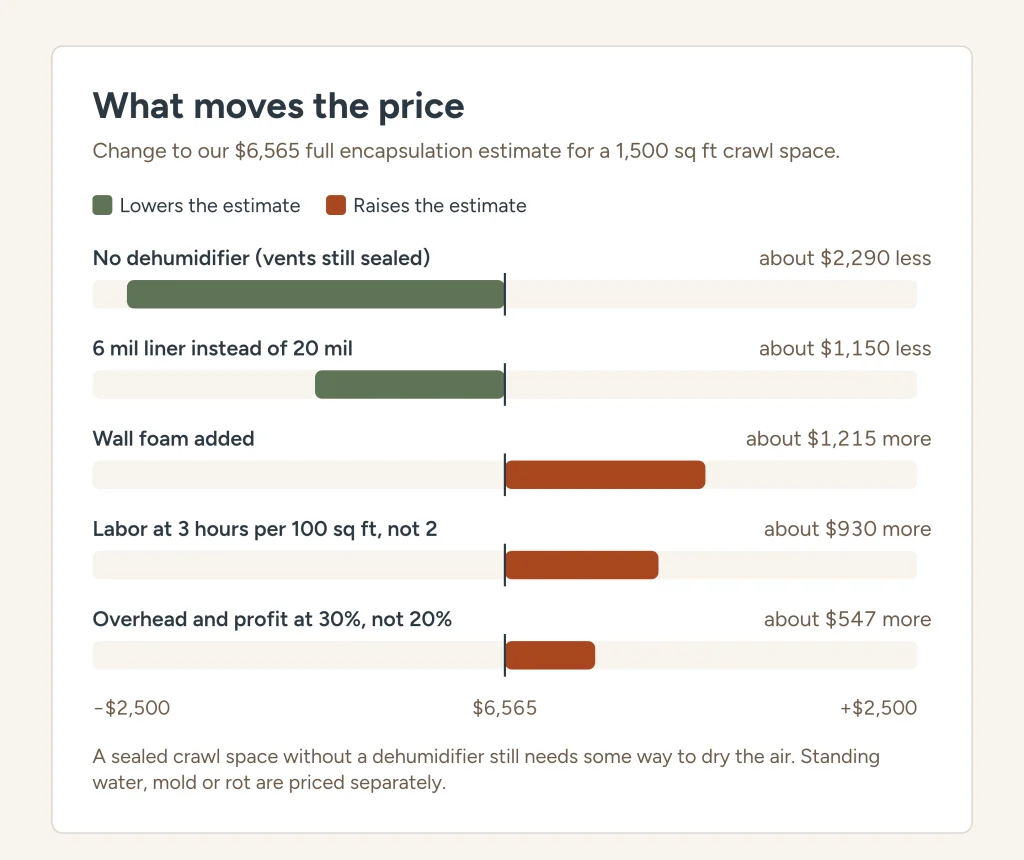
What moves the price up or down
| Change from our example | Effect on the estimate |
|---|---|
| No dehumidifier (vents still sealed) | About $2,290 less: $1,769.99 for the unit, 4 hours of labor, and 20% on both. A sealed crawl space still needs some way to dry the air, and that costs money too |
| 6 mil liner instead of 20 mil | About $1,150 less: $960 of liner plus 20% |
| Wall foam added | About $1,215 more |
| Labor at 3 hours per 100 sq ft instead of 2 | About $930 more |
| Overhead and profit at 30% instead of 20% | About $547 more |
| Standing water, mold or rot to fix first | Priced separately: get those quotes before the encapsulation quote |
Check the crawl space before you price it
A liner keeps ground moisture out. It doesn’t stop water flowing in, and it doesn’t repair damaged wood. Deal with these first:
- Standing or running water. If water collects after rain, the fix is usually outside (grading, gutters) or a drain and pump inside. The same DOE job aid says a vapor retarder should not interfere with established drainage patterns. Our guides to French drain installation costs and sump pump replacement costs price that work.
- Sagging floors, rotted joists or cracked walls. These are structural problems, so get an independent assessment from someone who isn’t selling the repair, such as a structural engineer. A crack alone doesn’t show the cause. Our page on what a foundation inspection costs covers who does this. Don’t jack or shore up anything yourself. Our crawl space repair cost guide covers joists, supports and moisture damage.
- Mold. EPA advises keeping indoor humidity below 60 percent, ideally between 30 and 50 percent. For growth covering more than 10 sq ft, it points to its professional remediation guidance. A quote that treats mold should say what area and what method.
- Old insulation. If a crew will pull down old insulation and it may be vermiculite, EPA says to assume it contains asbestos and not disturb it, and to hire a professional asbestos contractor.
- Radon. EPA recommends fixing a home at 4 pCi/L or higher. For crawl space homes, its guide calls a plastic sheet over the earth with a fan drawing radon from under it the most effective method. Test before the liner goes down. If the result calls for mitigation, ask whether the radon system and the liner can be planned together, since both use a sheet over the ground.
Gas appliances, wiring and permits
Gas appliances. If a furnace or water heater in the crawl space burns gas, sealing the space changes the air it draws on. EPA’s radon guide, cited above, warns that pulling air out of a crawl space needs special attention to combustion appliance backdrafting. Have a licensed heating contractor check combustion air before the vents are closed, and ask for that check on the quote. CPSC advises CO alarms on every level of the home and outside sleeping areas. If you suspect carbon monoxide poisoning, get outside to fresh air right away and then call 911 (CPSC). If you smell gas, leave the house now. Don’t switch lights on or off, use a phone or start a car near the smell. Call 911 from a neighbor’s house or somewhere well away from the leak (PHMSA).
Wiring. A dehumidifier needs an outlet and a place to drain. Adding a circuit or outlet is electrician’s work, and most states require electricians to be licensed (BLS). If the quote doesn’t mention power, ask how the unit will be supplied.
Permits and code. Codes are adopted and amended locally, so there’s no single national rule. Two examples show how much they vary:
- Larimer County, Colorado (handout updated 28 April 2026, citing the 2024 IRC) requires an unvented crawl space to have at least R-15 continuous wall insulation, a sealed Class I vapor retarder on the ground, no exterior vents, and one of four options: an exhaust fan, a conditioned air supply, a plenum, or dehumidification sized to the maker’s specifications. An unvented crawl space left unconditioned instead needs R-30 in the floor and a dehumidifier.
- South Carolina’s adopted version (S.C. Code Regs. 8-1221) calls for a ground cover meeting ASTM E1745 Class A, joints overlapped 6 inches and sealed, and at least 6 inches up the stem wall.
So in Larimer County, sealing the vents can bring an insulation requirement with it. The 2.5-inch board in our example is listed at R-10 on one part of the seller’s page and R-11 on another, either way below R-15. DOE’s job aid for crawl space wall insulation says foam products must meet the fire safety requirements of the authority having jurisdiction, and that insulation left exposed should be a fire-rated material. Your local building department decides what applies, and whether the job needs a permit at all.
Termites. The same DOE job aid calls for a 3-inch termite inspection gap between the top of the insulation and the wood where termite pressure exists, and notes that this varies by region. If you have a termite contract, ask your termite company before work starts whether the liner or foam affects it.
Does it lower energy bills?
Sometimes, but probably by less than sellers say. HomeGuide says encapsulation “lowers energy bills by 10% to 30%” but doesn’t give a source. The strongest public evidence we found is a DOE-funded field study by Advanced Energy of twelve matched 1,040 sq ft homes in eastern North Carolina. Homes with closed crawl spaces saved 15% or more on heating and cooling energy. Assuming heating and cooling are 40% of a home’s energy use, the report puts that at about a 6% cut in total household energy. It also found that the crawl spaces stayed substantially drier than wall-vented ones in a humid climate.
Those were twelve small homes of one design in one mixed-humid climate. The report suggests savings could be larger in typical houses, because its comparison homes were better built than most in North Carolina, but that wasn’t measured. A dehumidifier also adds to the bill: about $277 a year in our example. So whether a household saves money depends on the climate, the house and how long the dehumidifier runs. Budget for encapsulation as a moisture fix, and treat any energy saving as a bonus you’d need to measure.
What a quote should list
- Liner thickness in mil, whether it’s reinforced, and its ASTM E1745 class if your code names one
- What gets covered: floor, walls (to what height), piers, and how the top edge is fastened and sealed
- Seam overlap and taping
- How many vents will be sealed and how, and whether the access door is sealed and insulated
- Rim joist air sealing, plus wall insulation type, thickness and R-value, if included
- Dehumidifier model, rated pints a day, where it drains, how it’s powered, and its warranty
- The humidity it’s set to hold, and how you can check it
- Debris and old insulation removal, mold treatment area and method, drainage or sump work, each priced separately
- Permit, inspection, and who arranges a combustion air check if there are gas appliances
- Warranty: what it covers, for how long, and whether it transfers to a buyer
Enter the line prices into the calculator. A quote well above your estimate isn’t necessarily wrong, because access, region and repairs all add real cost. But it should be able to show which lines are higher, and why.
Red flags
- A single price for “encapsulation” with no line items or liner spec
- A mold or air quality warning with no humidity readings, photos or area measured
- Structural jacks or piers sold with the encapsulation, without an independent assessment
- A liner over standing water, with no plan for where the water goes
- Vents sealed with no plan to dry the air: no dehumidifier, air supply or exhaust fan
- Pressure to sign on the day, or a “lifetime” warranty without written terms
If water comes through the foundation walls rather than up from the ground, compare this with what foundation waterproofing costs. The two are often sold together.
Sources and notes
CostPlain doesn’t install crawl space systems, has no crews, and takes no fees from contractors or sellers. We build estimates from public data. The supplier named above was chosen because its list prices were publicly readable. We don’t recommend it, and other sellers’ prices may be lower. Retail prices, wages and published ranges change, so check them against your own quotes. A licensed local contractor and your permit office decide what your crawl space needs. This page is general information, not professional, legal or financial advice.
Sources checked on 3 November 2026.
Formulas and sources
- Crawl space floor area: Arithmetic on the reader's own entries, no outside figure
- Perimeter: Arithmetic on the reader's own entries, no outside figure
- Height of liner up the wall: DOE Weatherization Job Aid 16-1: Install or Repair a Crawl Space Vapor Retarder (June 2024)
- Area to cover, before overlaps: DOE Weatherization Job Aid 16-1: Install or Repair a Crawl Space Vapor Retarder (June 2024)
- Liner to buy, with overlaps and waste: DOE Weatherization Job Aid 16-1: Install or Repair a Crawl Space Vapor Retarder (June 2024)
- Liner rolls: Crawlspace Depot: 20 mil reinforced liner, 12 x 100 ft, $559.99 (seen 3 Nov 2026, retailer)
- Liner cost: Crawlspace Depot: 20 mil reinforced liner, 12 x 100 ft, $559.99 (seen 3 Nov 2026, retailer)
- Feet of seams to tape: DOE Weatherization Job Aid 16-1: Install or Repair a Crawl Space Vapor Retarder (June 2024)
- Seam tape cost: Crawlspace Depot: polyethylene seam tape, 4 in x 180 ft (seen 3 Nov 2026, retailer)
- Butyl tape cost: Crawlspace Depot: double-sided butyl tape, 1.5 in x 100 ft (seen 3 Nov 2026, retailer)
- Vent covers cost: Crawlspace Depot: foundation vent cover, 16 x 8 in (seen 3 Nov 2026, retailer)
- Wall area to insulate: DOE Weatherization Job Aid 12-4: Insulate Conditioned Crawl Space Wall (June 2024)
- Wall foam cost: Crawlspace Depot: EPS foam board, 48 x 94 x 2.5 in (seen 3 Nov 2026, retailer)
- Dehumidifier cost: Crawlspace Depot: Aprilaire E070 dehumidifier, $1,769.99 (seen 3 Nov 2026, retailer)
- Materials and equipment: Arithmetic on the reader's own entries, no outside figure
- Labor hours: Arithmetic on the reader's own entries, no outside figure
- Employer cost per labor hour: BLS Employer Costs for Employee Compensation, June 2026, construction (Table 4)
- Labor cost: BLS Occupational Outlook Handbook: Insulation Workers (May 2025 wages)
- Materials plus labor: Arithmetic on the reader's own entries, no outside figure
- Overhead and profit: FEMA NFIP Bulletin W-13064: Allowance for Overhead and Profit (2013)
- Estimated total: Arithmetic on the reader's own entries, no outside figure
- Estimate per square foot of floor: Arithmetic on the reader's own entries, no outside figure
- Dehumidifier electricity per year: Aprilaire E070 crawl space dehumidifier specification sheet: 5.8 A at 120 V
- Dehumidifier electricity cost per year: EIA Electric Power Monthly Table 5.6.A: residential average price, August 2026
- Employer cost per dollar of wages, construction (1.44, as of 2026-11-03): BLS Employer Costs for Employee Compensation, June 2026, construction (Table 4)
- Feet of floor each 12 ft liner width covers after a 12-inch overlap (11, as of 2026-11-03): DOE Weatherization Job Aid 16-1: Install or Repair a Crawl Space Vapor Retarder (June 2024)
- Feet of seam tape per roll (180, as of 2026-11-03): Crawlspace Depot: polyethylene seam tape, 4 in x 180 ft (seen 3 Nov 2026, retailer)
- Feet of butyl tape per roll (100, as of 2026-11-03): Crawlspace Depot: double-sided butyl tape, 1.5 in x 100 ft (seen 3 Nov 2026, retailer)
- Square feet per 48 x 94 in foam board (31.333, as of 2026-11-03): Crawlspace Depot: EPS foam board, 48 x 94 x 2.5 in (seen 3 Nov 2026, retailer)
Sources
- Angi: How Much Does Crawl Space Encapsulation Cost? (updated 28 Oct 2026, lead-generation site)
- HomeAdvisor: Cost to Encapsulate a Crawl Space (updated 20 Jun 2026, lead-generation site)
- HomeGuide: Crawl Space Encapsulation Cost (14 Jan 2026, lead-generation site)
- This Old House: Crawl Space Encapsulation Cost (updated 13 Mar 2026)
- Bob Vila: Crawl Space Encapsulation Cost (updated 20 Jul 2022)
- Polyguard: Crawl Space Encapsulation Cost (17 Oct 2024, maker's blog)
- Crawlspace Depot: 20 mil reinforced liner, 12 x 100 ft (seen 3 Nov 2026)
- Crawlspace Depot: 6 mil liner, 12 x 100 ft (seen 3 Nov 2026)
- Crawlspace Depot: polyethylene seam tape (seen 3 Nov 2026)
- Crawlspace Depot: double-sided butyl tape (seen 3 Nov 2026)
- Crawlspace Depot: foundation vent cover (seen 3 Nov 2026)
- Crawlspace Depot: EPS foam insulation board (seen 3 Nov 2026)
- Crawlspace Depot: 70-pint crawl space dehumidifier (seen 3 Nov 2026)
- Dehumidifier specification sheet, model E070 (current draw and capacity)
- BLS Occupational Outlook Handbook: Insulation Workers (May 2025 wages)
- BLS Employer Costs for Employee Compensation, June 2026, Table 4
- FEMA NFIP Bulletin W-13064: Allowance for Overhead and Profit
- EIA Electric Power Monthly Table 5.6.A: average price of electricity, August 2026
- DOE Weatherization Job Aid 16-1: Install or Repair a Crawl Space Vapor Retarder (June 2024)
- DOE Weatherization Job Aid 12-4: Insulate Conditioned Crawl Space Wall (June 2024)
- Larimer County, Colorado: Crawlspace Requirements (updated 28 Apr 2026)
- S.C. Code Regs. 8-1221: IRC R408.3 Unvented Crawl Space (Cornell LII)
- EPA: A Brief Guide to Mold, Moisture and Your Home (updated 18 Feb 2026)
- EPA: Protect Your Family from Asbestos-Contaminated Vermiculite Insulation
- EPA: Consumer's Guide to Radon Reduction, EPA 402/K-10/005 (2025)
- Advanced Energy for DOE: Closed Crawl Space Performance, final technical report (January 2008)
- Advanced Energy for DOE: Ventilated Versus Sealed Crawl Spaces in the South (June 2005)
- CPSC: Carbon Monoxide Information Center
- PHMSA: Recognizing and Responding to Natural Gas Emergencies
- BLS Occupational Outlook Handbook: Electricians