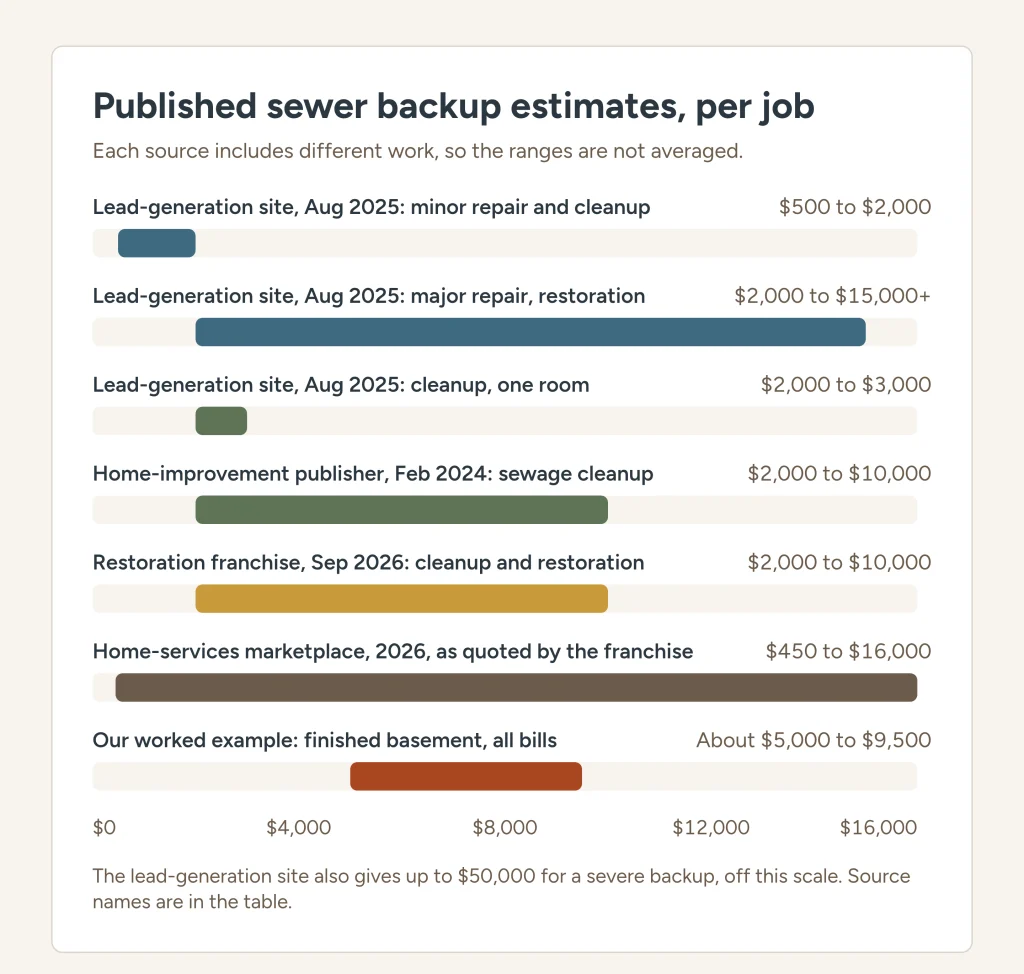
A sewer backup usually means three bills: a plumber to clear the line, usually a few hundred dollars; a cleanup crew; and repairs to whatever the sewage soaked. HomeGuide (August 2025) puts minor repair and cleanup at $500 to $2,000 and major repair and restoration at $2,000 to $15,000 or more. Its separate cleanup guide gives $7 to $15 or more per square foot. Our worked example for a 400-square-foot finished basement comes to about $5,000 to $9,500 once new flooring is included. Insurance often pays nothing unless you added backup coverage before it happened. This page is part of our plumbing and sewer costs section.
Below are the published estimates side by side, a line-by-line build-up you can check, what insurance and the city may and may not cover, and what a backwater valve costs if you want to stop the next one.
Health first
Sewage is a health problem before it is a cost problem. EPA advises people to “avoid contact with the sewage as it may contain harmful pathogens” and to contact the local health department or regulatory agency for guidance. CDC’s cleanup guidance says to wear rubber boots, rubber gloves and goggles if sewage is involved, to “remove and discard drywall and insulation that has been contaminated with sewage or floodwater”, and to keep children and pets away until cleanup is finished.
Time matters for the bill too. EPA says that if wet materials are dried within 24 to 48 hours, in most cases mold will not grow. A backup left over a weekend can turn a cleanup into a mold job.
Published estimates side by side
No government agency publishes prices for sewer backup work. These are published estimates from commercial sites, and several of them sell leads or the service itself. We list each one with its date and what it measures. We don’t average them.
| Job | Published estimate | Source, date and what it measures |
|---|---|---|
| Clear a main sewer line | $329 to $402 per run | Homewyse, May 2026. Commercial estimator. One line under favorable conditions, with a 2-hour labor minimum. Root removal extra; excludes permits and sales tax |
| Clear a main sewer line | $250 average, $200 to $600 typical | Fixr, updated January 2025. Snaking $150 to $375, hydro jetting $250 to $1,000, and $300 to $600 to clean or repair the line when it needs a video inspection |
| Clear the line, by method | Snaking $200 to $500, hydro jetting $600 to $1,400 | HomeGuide, 26 August 2025. Lead-generation site. Camera inspection $125 to $500 |
| Sewer backup repair and cleanup | $500 to $2,000 minor; $2,000 to $15,000+ major; up to $50,000 severe | HomeGuide, same page. Mixes the plumbing fix and the cleanup in one figure |
| Sewage cleanup | $7 to $15+ per sq ft; $2,000 to $3,000 for one room | HomeGuide, 22 August 2025. Cleanup and disinfection; rebuilding priced separately |
| Sewage cleanup | $2,000 to $10,000; $7.50 per sq ft for blackwater | Bob Vila, updated February 2024, citing Angi and others. Older than our 12-month limit, shown for comparison |
| Cleanup and restoration | $2,000 to $10,000 | SERVPRO, 8 September 2026. A restoration franchise, so a seller of the service. The same page quotes Angi’s 2026 figures as $450 to $16,000. We could not open Angi’s page |
| Insured water damage claims | $15,400 average paid per claim | Insurance Information Institute, from ISO (Verisk) data, 2019 to 2023. All “water damage and freezing” claims, not just sewer backups, and only what insurers paid |
The per-square-foot cleanup figures roughly agree: $7 to $15 at HomeGuide, $7.50 for sewage at Bob Vila. The totals don’t, because each source includes different work. That is the next section.
Step one: clearing the line
Until the line is open, every flush or load of laundry can bring more back up. A plumber or drain firm runs a cable machine (snaking) or a high-pressure water jet through a cleanout. A camera inspection then shows whether it was a soft clog, roots or a broken pipe. EPA’s list of possible causes of sewer overflows includes blockages, line breaks, and defects that let stormwater and groundwater overload the system.
What the labor itself costs is small next to the bill. The median plumber earned $30.67 an hour in May 2025 (median hourly wage, BLS). Construction employers paid $51.96 an hour in total compensation for every $36.13 in wages in June 2026 (BLS), so we multiply wages by 1.44 to cover benefits and payroll taxes. Two hours, our assumption and Homewyse’s minimum, is 2 × $30.67 × 1.44 = $88.33, or $106 with 20% overhead and profit. The published $250 to $400 call is two to four times that. The difference pays for the truck, the machine and camera, drive time, dispatch and the hours a service plumber isn’t billing.
A backup can come during a storm, at night or on a weekend, and you may pay more then. One restoration contractor’s rate card on a State of Iowa contract, effective 22 May 2026, charges 1.5 times its normal rate on evenings, weekends and past 8 hours a day, and twice its normal rate on holidays. Ask about the after-hours rate when you call.
If the camera shows a collapsed or root-filled pipe, the job becomes a repair or replacement, usually priced by the foot. Our sewer line replacement cost guide covers those choices.
Cleanup: a worked example
Here is a cleanup built up line by line, using our estimating method. The house: a 400-square-foot finished basement room, 20 by 20 feet, carpeted, with drywall on 80 feet of wall. Sewage came up through the floor drain and was caught within a day. The crew pumps it out, pulls the carpet and pad, cuts out the wet bottom 2 feet of drywall and any insulation behind it, cleans and disinfects, and dries the room.
Labor uses the BLS median for hazardous materials removal workers, $23.78 an hour in May 2025, the nearest federal occupation to a restoration technician (BLS lists mold among the substances they handle). Construction laborers, at $22.66, are close. That figure and the drywall installer and taper wages further down come from BLS’s May 2025 national wage tables (median hourly wage). Equipment and supplies come from the rate card on the State of Iowa contract named above. Those are a contractor’s billed prices, not retail.
| Line | Working | Cost |
|---|---|---|
| Crew labor, 24 hours (our assumption) | 24 h × $23.78 × 1.44 | $821.84 |
| Air movers, 4 for 3 days | 12 unit-days × $29.00 | $348.00 |
| Dehumidifier, extra-large, 3 days | 3 × $125.00 | $375.00 |
| Air scrubber, compact, 3 days | 3 × $80.00 | $240.00 |
| Supplies: contractor bags, 2 gal disinfectant, 8 coveralls, gloves, 6-mil plastic sheeting | $44.68 + $112.62 + $74.88 + $37.68 + $118.34 | $388.20 |
| Dump trailer, 1 day | Rate card, equipment only; landfill fees extra | $105.00 |
| Overhead and profit, 20% of labor (our assumption) | $821.84 × 0.20 | $164.37 |
| Cleanup total | About $6.11 per sq ft | $2,442.41 |
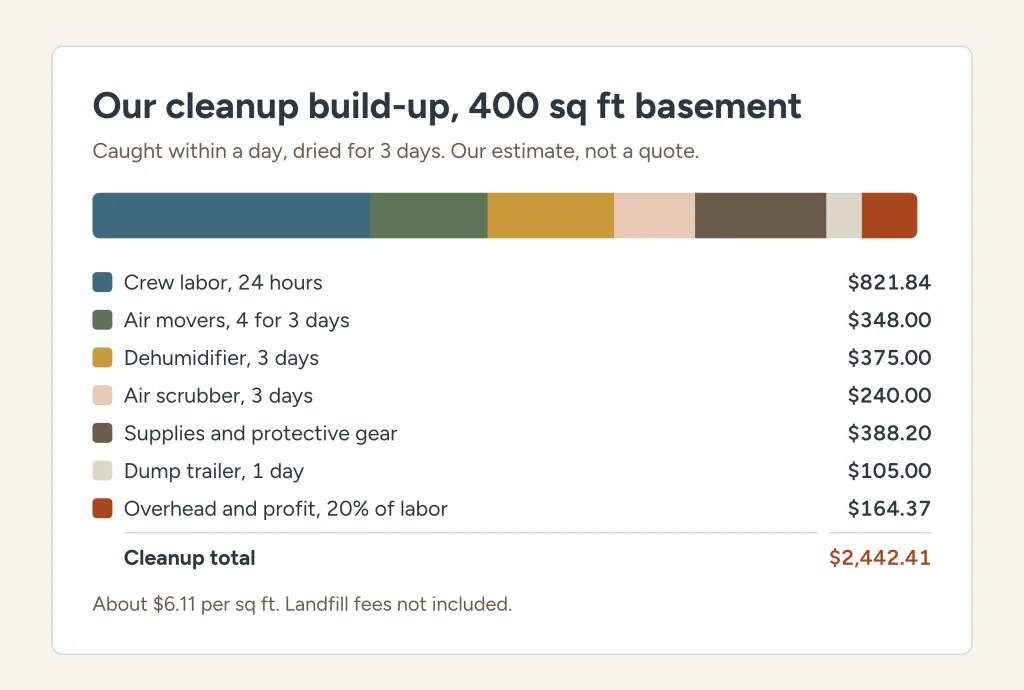
Our assumptions, explained. Twenty-four hours is two people for a full first day of extraction, tear-out and disinfecting, plus about 8 hours over the next days for moisture readings, moving equipment and the final clean. Three days of drying is also our assumption, for a room caught early; a wetter or older backup takes longer, and the moisture readings should show why. We put the 20% overhead and profit on labor only, because the equipment and supply prices are already a contractor’s billed rates. Insurance estimates often use 10% overhead plus 10% profit, and FEMA’s flood program calls that the typical charge.
The same job at a billed labor rate. The Iowa rate card bills a restoration technician at $63.75 an hour, about 1.9 times our loaded wage of $34.24. At that rate the 24 hours come to $1,530 and the cleanup to $2,986.20, or $7.47 a square foot. That sits at the low end of HomeGuide’s $7 to $15 and close to Bob Vila’s $7.50. The card also adds a 3% small-tools surcharge on labor, and its dump trailer is priced as equipment only, so landfill fees come on top.
Putting the room back
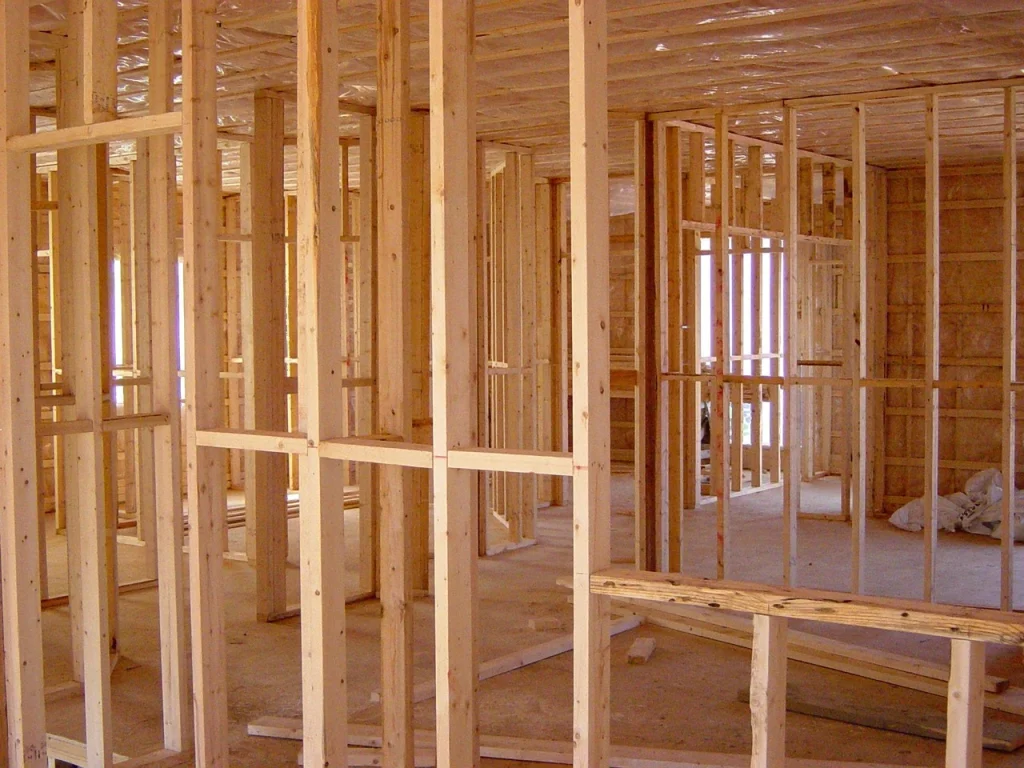
Cleanup leaves bare studs and a concrete floor. Rebuilding is often a separate bill, sometimes from a different contractor. In a home built before 1978, paid work that disturbs painted drywall or trim falls under EPA’s lead rules: the firm must be lead-safe certified, and some states run their own programs. If the wall cavities hold vermiculite insulation, EPA says to assume it contains asbestos, leave it undisturbed and hire a professional asbestos contractor before any work that would disturb it.
| Line | Working | Cost |
|---|---|---|
| Drywall: 80 ft of wall × 2 ft = 160 sq ft, 5 sheets cut into strips plus 1 spare | 6 × $17.16, a 4×8 ft, ½-inch sheet at a hardware store’s site, 3 Nov 2026 | $102.96 |
| Hang drywall, 3 hours (our assumption) | 3 h × $28.33 (BLS drywall installers) × 1.44 | $122.39 |
| Tape and finish, 6 hours over three visits (our assumption) | 6 h × $32.82 (BLS tapers) × 1.44 | $283.56 |
| Overhead and profit, 20% (our assumption) | $508.91 × 0.20 | $101.78 |
| Wall repair total | Before tape, mud, screws, insulation, baseboard and paint | $610.69 |
Flooring is usually the largest rebuild line, and it depends entirely on what you choose. HomeGuide’s flooring replacement figure, $4 to $15 per square foot installed, gives $1,600 to $6,000 for this room. That is a published range, not our build-up. Our drywall cost calculator works out larger wall repairs from your own measurements.
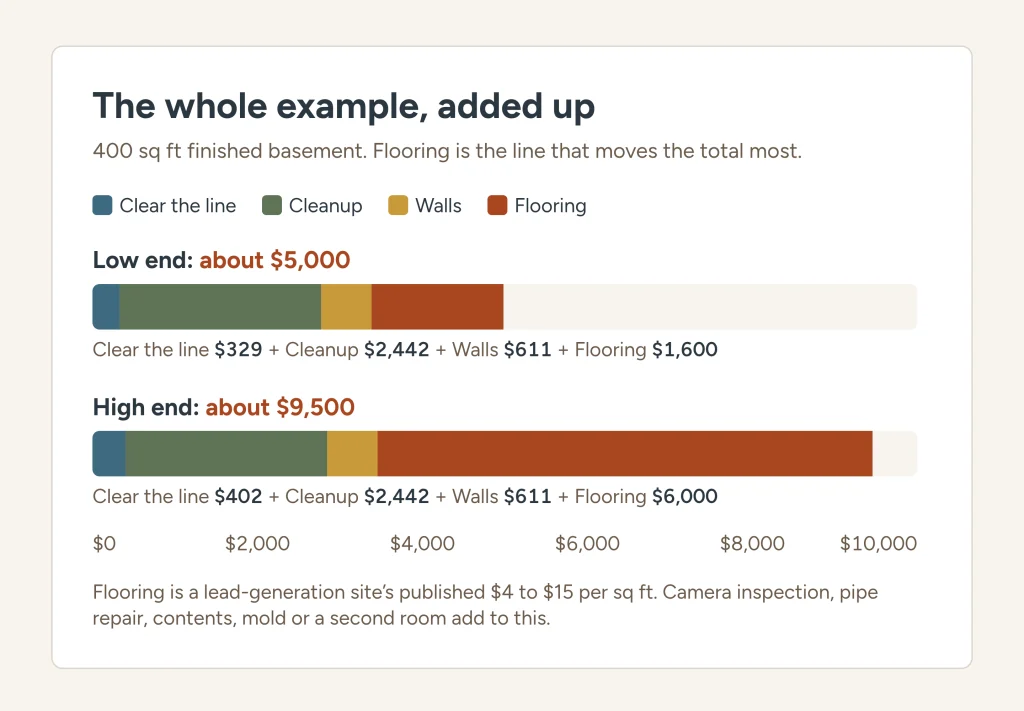
The whole example, added up: $329 to $402 to clear the line (Homewyse), $2,442 for cleanup, $611 for walls and $1,600 to $6,000 for flooring. That comes to about $5,000 to $9,500, or up to about $10,000 at the billed cleanup rate. A camera inspection, a pipe repair, contents, mold or a second room add to that.
Why the numbers differ
- One bill or three. HomeGuide’s “$500 to $2,000” sewer backup figure mixes clearing the line with cleanup. SERVPRO’s $2,000 to $10,000 is cleanup and restoration. Homewyse and Fixr price only clearing the line. Check which one a figure covers before comparing it with a quote.
- Finished or unfinished space. In an unfinished basement with a concrete floor, the job is mostly pumping, scrubbing and disinfecting. Carpet, drywall and insulation multiply it, because CDC says sewage-soaked drywall and insulation are thrown away, not dried.
- Time. A backup found within hours is a smaller job than one found after a weekend away, when more material is wet and mold may have started.
- Wage or billed rate. Our build-up starts from what workers earn. Contractors bill more: the Iowa rate card’s technician rate is about 1.9 times our loaded wage, and more after hours.
- Insurance averages. The $15,400 average water claim covers only claims insurers paid. It includes burst pipes and freezing and leaves out backups no policy covered.
- What stays out. Homewyse charges extra for root removal and leaves out permits. Our example leaves out landfill fees, paint and contents. Most published ranges don’t say what they leave out.
What insurance may cover
Homeowners insurance. Many homeowners policies don’t cover water that backs up through sewers or drains unless you added that coverage, often as an endorsement, before the backup. Maryland, for one, requires insurers to offer it in writing at application and renewal for backups not caused by the insured’s negligence, which tells you it isn’t automatic there. Look for wording such as “water backup”, “sewer or drain backup” or “sump overflow” in your declarations page.
Check the limit, not just the line. Backup coverage usually has its own limit and deductible. One insurer’s published South Carolina homeowners rules offer water backup coverage with limits up to $50,000, a deductible of $1,000 or the policy’s other-perils deductible, whichever is greater, and on an existing policy it can be added only at renewal. Our example basement came to $5,000 to $9,500, so check which limit you chose. A backup endorsement is about water damage. Whether anything pays to dig up and fix a broken pipe outside is a separate question to put to your insurer.
Flood insurance. FEMA’s flood program says “damage caused by sewer backup is covered by flood insurance only if it directly results from flooding”. A backup from a clogged or broken line on an ordinary day isn’t flood.
The city. If the backup came from a blocked public sewer, report it to your sewer utility the same day and ask how its claims process works. Don’t count on payment. Philadelphia’s water department, for example, says in its 2026 basement backup program guide that the city is responsible for property damage only when its own infrastructure fails, such as a water main break or a clog in the sewer, and that it considers basement backups the result of extreme natural events. Rules differ from city to city.
For any claim, take photos and keep the plumber’s camera findings and every invoice. Coverage depends on your own policy wording and your state, so read your policy and ask your agent or insurer. This is general information, not insurance or legal advice.
Stopping the next one
A backwater valve lets wastewater flow out of the house but closes when the sewer pushes back. Philadelphia’s guide notes that it protects only against flooding “caused by the sewer lateral”, not against water seeping through walls and floors, and that the owner has to maintain it. Delaware’s environment department recommends that a plumber install one, because some pipes are harder to reach than others. Madison, Wisconsin’s rebate program requires a city building permit and a Wisconsin-licensed plumber; your building department sets the rules where you live.
The valve is cheap. A 4-inch PVC backwater valve was listed at $39.99 on one hardware store’s site on 3 November 2026, though out of stock that day. The cost is in the labor: cutting the basement slab or digging outside to reach the main drain, cutting the valve in, and patching. Our build-up for an inside install: 8 hours of plumber time (8 × $30.67 × 1.44 = $353.32) plus 8 hours of laborer time (8 × $22.66 × 1.44 = $261.04), both our assumptions, plus the valve. That is $654.35, or $785.22 with 20% overhead and profit, before concrete, an access box and the permit.
Published figures run from Delaware’s 2022 estimate of $200 to $300 per sewer line valve, installed, to city programs that allow far more. Madison reimburses 75% of the lowest quote, up to $1,500, for 1- and 2-unit homes more than five years old. DC Water’s rebate covers up to $6,000 for eligible homes with a documented backup. Philadelphia installs valves free for qualifying homes whose basements take back water from the city sewer, once your lateral is found to be in good working order. Program caps aren’t prices. Ask your sewer utility whether it runs a program before you hire anyone.
Other water in the basement has other causes. If the problem is groundwater rather than sewage, see our guides to sump pump replacement cost and foundation waterproofing cost.
What a quote should list
A cleanup quote you can check lists:
- The area affected in square feet, and which materials come out: carpet and pad, drywall to what height, insulation, baseboard
- Labor hours by role, and the hourly rate, including any after-hours rate
- Each piece of equipment, how many, and for how many days
- Moisture readings at the start and at the end, so you can see why drying took as long as it did
- Disinfectant, protective gear, containment, and disposal with landfill fees
- What isn’t included: rebuilding, contents, mold work, the plumbing fix
Red flags: equipment billed for days with no moisture readings to show it was needed; a single lump sum for “remediation” with no square footage; and pressure to sign papers about your insurance claim before you’ve read them. For the plumbing side, ask to see the camera footage and keep a copy. It shows whether you need a repair or just a cleaning, and it helps with any claim.
Questions to ask: Is the line fully clear, and what did the camera show? Was this my lateral or the city main? How many days of drying do you expect, and how will you measure when it’s done? Are the rebuild and the cleanup priced separately?
About these figures
CostPlain does no plumbing or restoration work, has no crews, and takes no fees from contractors, insurers or sellers. We build estimates from public data. The stores and the rate card named above were used because their prices were publicly readable. We don’t recommend them, and other prices may be lower. Wages, prices and published ranges change, so check them against your own quotes. A licensed local contractor and your local health and building departments decide what your home needs. This page is general information, not professional, legal, insurance or financial advice.
Sources checked on 3 November 2026.
Sources
- HomeGuide: Sewer backup repair cost (26 August 2025, lead-generation site)
- HomeGuide: Sewage cleanup cost (22 August 2025, lead-generation site)
- Homewyse: Cost to clean a sewer line (May 2026, commercial estimator)
- Fixr: Cost to clean a sewer line (updated 31 January 2025, commercial)
- Bob Vila: Sewage backup cleanup cost (updated 15 February 2024)
- SERVPRO: How much does it cost to fix a sewer backup? (8 September 2026, restoration franchise)
- Insurance Information Institute: Facts and statistics, homeowners and renters insurance (ISO data 2019-2023)
- Restoration contractor rate schedule on a State of Iowa contract (effective 22 May 2026)
- BLS Occupational Outlook Handbook: Plumbers, pipefitters and steamfitters (May 2025 wages)
- BLS Occupational Outlook Handbook: Hazardous materials removal workers (May 2025 wages, modified 27 August 2026)
- BLS Occupational Employment and Wage Statistics, May 2025 national tables (construction laborers, drywall installers, tapers)
- BLS Employer Costs for Employee Compensation, June 2026 (released 9 September 2026)
- FEMA NFIP Bulletin W-13064: Allowance for overhead and profit (8 October 2013)
- FEMA NFIP: Types of coverage
- Maryland Code, Insurance Article, section 19-202
- Insurer underwriting guideline: Water backup and sump discharge or overflow coverage, South Carolina homeowners
- CDC: Guidelines for cleaning safely after a disaster (reviewed 26 August 2026)
- EPA: Resolving septic system malfunctions (updated 11 March 2026)
- EPA: A brief guide to mold, moisture and your home (updated 18 February 2026)
- EPA: Sanitary sewer overflows (updated 13 April 2026)
- EPA: Renovation, Repair and Painting Program (updated 17 June 2026)
- EPA: Protect your family from asbestos-contaminated vermiculite insulation (updated 17 April 2026)
- Philadelphia Water Department: Basement Backup Protection Program summary and application (2026)
- City of Madison: Backwater valve program
- DC Water: Backwater valve information and rebate program
- Delaware DNREC I-ADAPT: Install backflow valves (2022 dollars)
- Hemlock Hardware: 4-inch PVC backwater valve listing (seen 3 November 2026)
- K&K Hardware: 1/2-inch 4×8 regular drywall listing (seen 3 November 2026)