Replacing a tank water heater with a similar one usually costs about $880 to $1,830 installed. That’s Angi’s 2026 range (updated 16 October 2026), which Angi says is based on 30,979 projects by its pros, with an average of $1,348. Angi puts a tankless replacement at $1,400 to $3,900. Our own line-by-line build-up for a 50-gallon gas tank, swapped like for like, comes to about $1,486 including a permit. The calculator on this page does the same sum for your job, then adds what the heater will cost to run. Other guides to pipes, sewers and leaks are in our plumbing and sewer section.
Two things matter as much as the heater you pick. The first is whether the new heater fits the old one’s gas line, vent, wiring and space. The second is the running cost: over 10 years, a standard electric tank in our example costs more to run than it did to buy and fit. The sections below show where each number comes from and what a quote should list.
Published estimates side by side
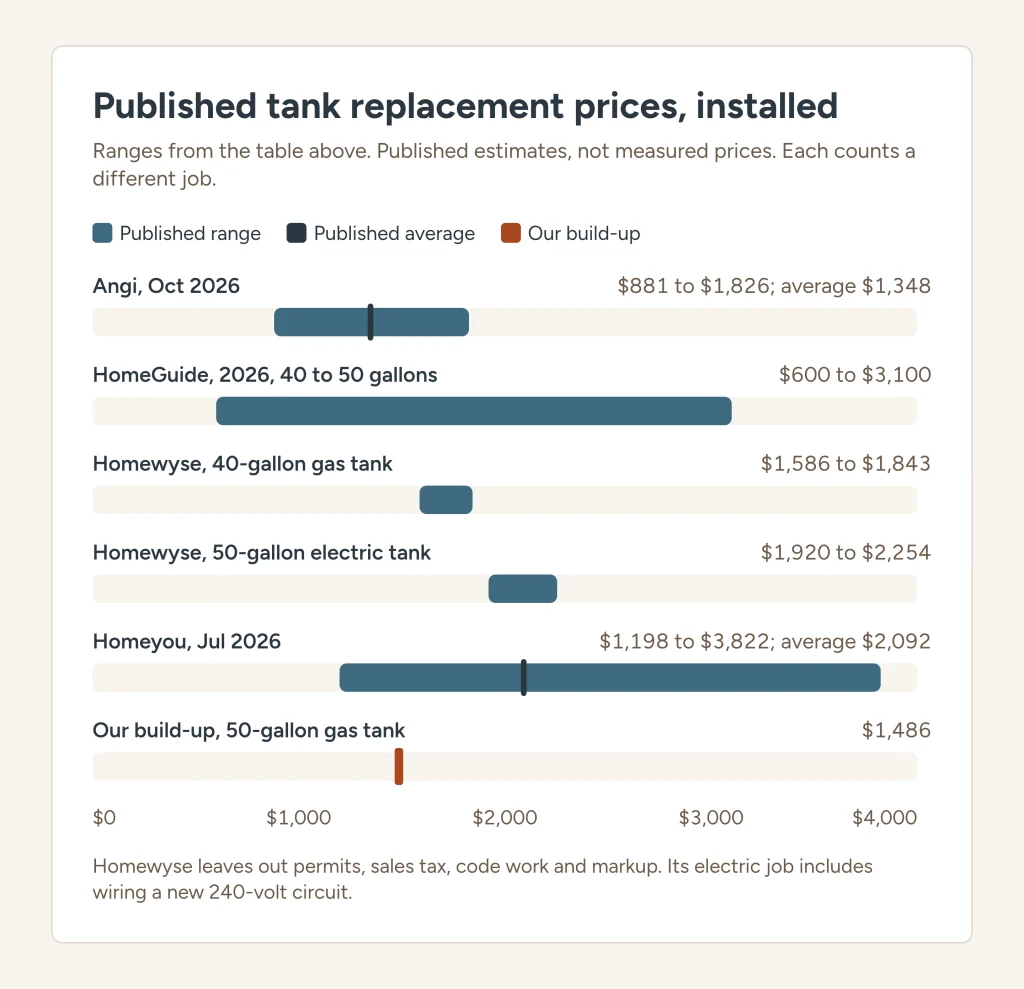
No government agency publishes installed prices for water heaters. The figures below come from commercial cost guides, most of which also sell leads to contractors. They are published estimates, not measured prices. We haven’t averaged them, because each one measures a different job.
| Source and date | Tank, installed | Tankless or heat pump, installed | What it measures |
|---|---|---|---|
| Angi, updated 16 Oct 2026 | $881 to $1,826; average $1,348 | Tankless $1,400 to $3,900 | Lead-generation site. Says it’s based on 30,979 projects by its pros. Labor for a tank swap $150 to $450; permits $25 to $300 |
| HomeGuide, 2026 edition, read 3 Nov 2026 | $600 to $3,100 for 40 to 50 gallons | Tankless $1,400 to $5,600; hybrid heat pump $2,000 to $4,600 | Lead-generation site. Lists disposal ($75 to $500) and code work ($75 to $500 or more) as extras |
| Homewyse, May 2026 | $1,586 to $1,843 for a 40-gallon, 40,000 Btu gas tank with a 9-year warranty | Not priced on this page | Commercial estimator. Leaves out permits, sales tax, code work and a general contractor’s 13% to 22% markup |
| Homewyse, May 2026 | $1,920 to $2,254 for a 50-gallon electric tank | Not priced on this page | Same estimator. Its labor includes installing a dedicated 240-volt, 40-amp circuit, which a straight swap that reuses the old circuit wouldn’t need. Lists removing the old heater as an option, with disposal fees not included. Leaves out permits, sales tax, code work and markup |
| Homeyou, updated 23 Jul 2026 | $1,198 to $3,822; average $2,092 | Tankless $1,703 to $6,533; average $3,328 | Lead-generation site. Gives no method for its figures |
We couldn’t open several other pages that rank for this search, including Home Depot’s, HomeAdvisor’s, Forbes Home’s, Modernize’s and Thumbtack’s. They blocked automated reading or returned errors on 3 November 2026, so they are not in the table.
Our build-up for a gas tank
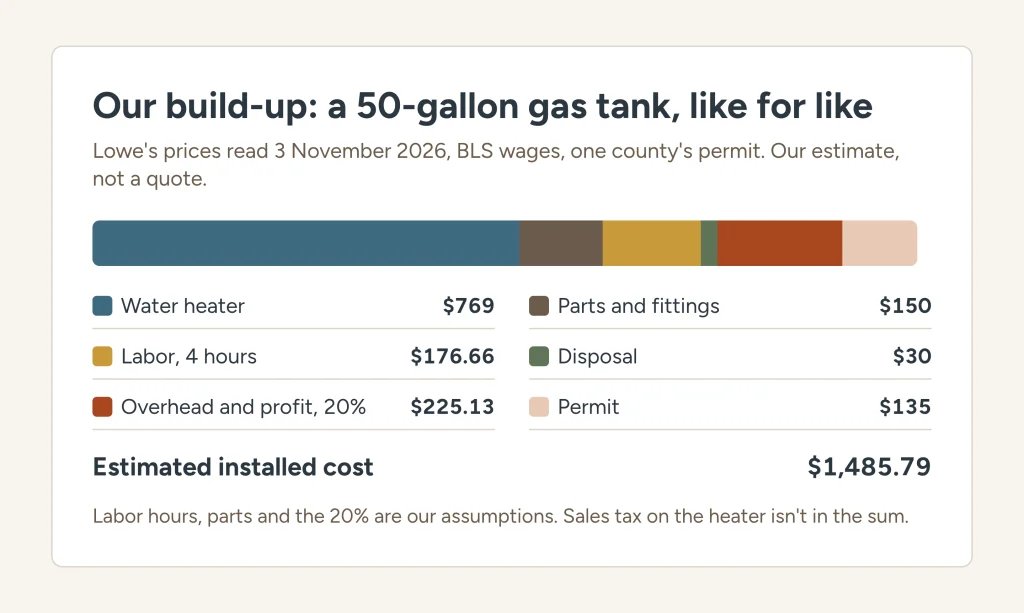
To show what’s inside a quote, we priced one common job line by line: a 50-gallon natural gas tank replacing an old one in the same spot, with the gas line, vent and water lines already in place. The method is explained in how we estimate costs. Labor hours and the overhead line are our assumptions, and you can change both in the calculator.
| Line | Figure | Where it comes from |
|---|---|---|
| Water heater | $769 | 50-gallon natural gas tank, 40,000 Btu, 6-year warranty, on Lowe’s website on 3 November 2026 |
| Parts and fittings | $150 | Our assumption. It includes two water connectors at $13.98 each and a 2-gallon expansion tank at $34.98 (Lowe’s, 3 November 2026), plus a gas connector, valve, vent pieces and sealant |
| Labor | $176.66 | 4 hours × $30.67 × 1.44. The 4 hours are our assumption for draining, disconnecting and removing the old tank, then setting, connecting, filling, testing and cleaning up. $30.67 is the median hourly wage for plumbers, May 2025 (BLS). Construction employers paid on average $51.96 an hour in total compensation for every $36.13 in wages in June 2026 (BLS), so we multiply the wage by 1.44 to cover benefits and payroll taxes |
| Disposal | $30 | Our assumption, set near Homewyse’s debris disposal line for its gas tank job, $28.35 to $32.25, May 2026. HomeGuide puts removal and disposal at $75 to $500 |
| Subtotal | $1,125.66 | $769 + $150 + $176.66 + $30 |
| Overhead and profit, 20% | $225.13 | Our assumption. It covers the office, insurance, vehicle, call-out time and margin. Insurance estimates often use 10% overhead plus 10% profit, which FEMA’s flood program calls the typical charge |
| Permit | $135 | One real example: Delaware County, Ohio, charges a $60 health district fee plus a $75 county change-out fee for a home water heater replacement, before small state fees. Your town’s fee will differ |
| Estimated installed cost | $1,485.79 | $1,125.66 + $225.13 + $135 |
That lands near the middle of Angi’s range and a little below Homewyse, which leaves out permits and markup. Check the labor line against published figures: Angi puts tank-swap labor at $150 to $450. Our $176.66 is labor at the employer’s cost. Overhead and profit on labor alone add another $35, about $212 in all, so it sits in the lower part of Angi’s range. If your plumber needs longer, raise the hours. Sales tax on the heater isn’t in the sum.
Electric, heat pump and tankless
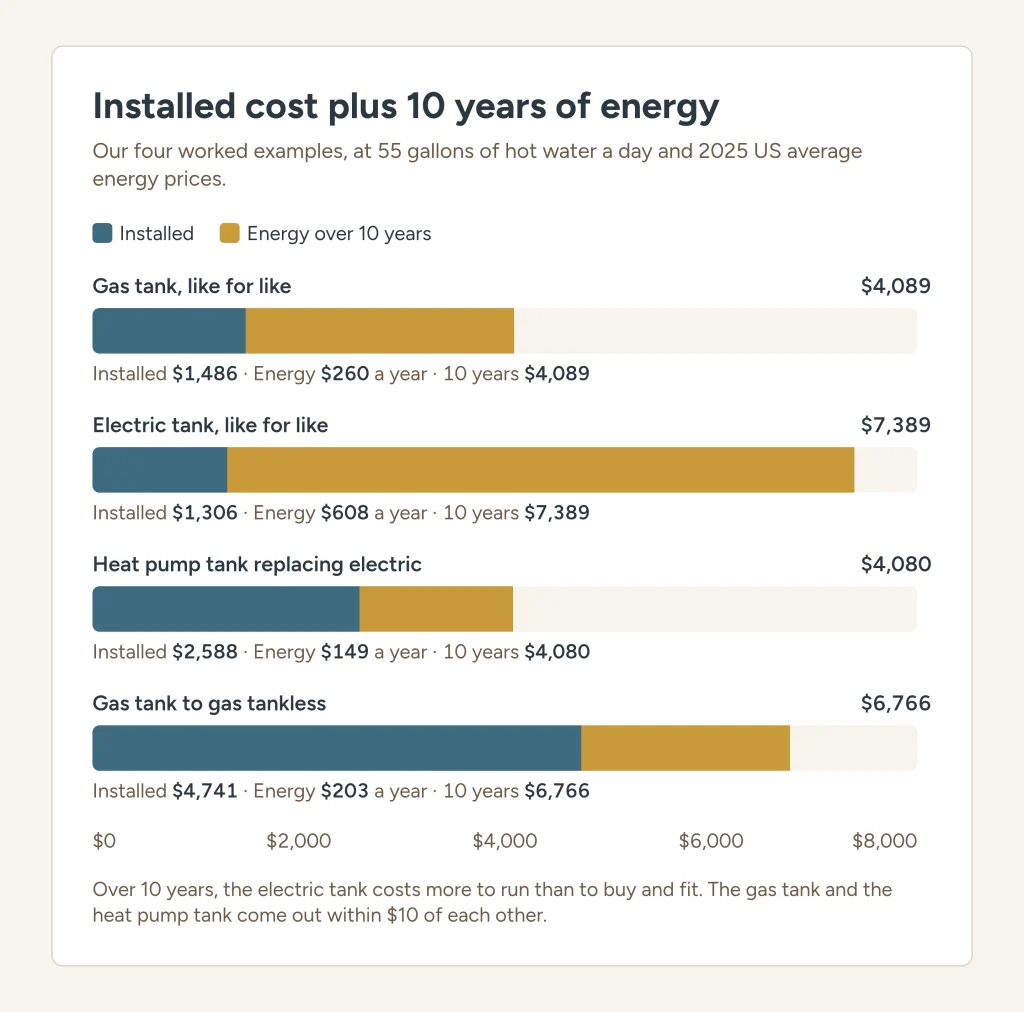
The same method gives these four worked examples. Each uses the build-up above, changes only what the table says, and assumes 55 gallons of hot water a day. Energy costs use the formula explained in the next section.
| Job | What changes | Installed | Energy per year | 10 years, both together |
|---|---|---|---|---|
| Gas tank, like for like | As above; UEF 0.63 | $1,486 | $260 | $4,089 |
| Electric tank, like for like | $669 heater (50-gallon, Lowe’s, 3 Nov 2026), $100 parts, UEF 0.92 | $1,306 | $608 | $7,389 |
| Heat pump tank replacing electric | $1,599 heater (50-gallon, UEF 3.75, Lowe’s sale price, 3 Nov 2026), 6 hours | $2,588 | $149 | $4,080 |
| Gas tank to gas tankless | $1,566.60 condensing tankless (Lowe’s, 3 Nov 2026), $300 parts, 10 hours, $1,500 for venting and a larger gas line, UEF 0.81 | $4,741 | $203 | $6,766 |
The parts allowances, the hours and the $1,500 allowance for the tankless switch are our assumptions, not published figures, so get those lines priced. A conversion often needs a new vent, a larger gas line and new mounting. Angi puts labor for converting a tank to tankless at $150 to $2,500, which shows how much this varies by house. The 0.81 is the federal minimum for gas tankless heaters, so a condensing unit’s own label will usually show a higher UEF and lower running costs. Our tankless water heater cost guide goes through sizing and the switch in detail. Its worked example puts the same heater in for $2,876, because it assumes 12 hours and leaves the permit, disposal and any gas line or venting work to be added from a quote; for running costs it uses the listed UEF of 0.98. Both sets of hours and allowances are our assumptions; a quote for your house decides.
A heat pump water heater needs more than a new tank. ENERGY STAR’s product page says these units belong in indoor spaces that stay between 40° and 90° F all year, with 1,000 cubic feet of air space around the heater. The Department of Energy’s Building America Solution Center notes that most makers require a 240-volt, 30-amp supply, and that the condensate needs a drain line or, in some places, a condensate pump. If there’s no spare circuit near the heater, an electrician’s line goes in Extra work. If your panel is full, see what replacing an electrical panel costs before you commit.
What it costs to run
The calculator uses the formula from the federal test procedure that produces each heater’s rating. That procedure assumes water comes in at 58° F and leaves at 125° F, a 67° F rise. Each gallon weighs 8.24 pounds at 125° F, and yearly energy is 365 days × gallons a day × 8.24 × 67, divided by the heater’s uniform energy factor (UEF). The test’s daily volumes are 38 gallons for low use, 55 for medium and 84 for high.
For the gas tank: 55 × 8.24 × 67 = 30,364 Btu a day, × 365 = 11.08 million Btu a year, ÷ 0.63 = 17.59 million Btu, or 175.9 therms. At $1.48 a therm that’s $260 a year. The $1.48 is EIA’s 2025 US residential gas price, $15.34 per thousand cubic feet, converted at EIA’s 2025 heat content of 1,036 Btu per cubic foot and 100,000 Btu a therm, the conversion EIA explains. For electric heaters, divide the Btu by 3,412 to get kWh. Electricity uses EIA’s 2025 residential average of 17.23 cents per kWh. January to August 2026 averaged 18.19 cents, which is preliminary.
Where the UEF figures come from. The yellow EnergyGuide label or the spec sheet gives your model’s UEF. Federal rules set the floor. For heaters made before 6 May 2029, a 50-gallon gas tank must reach about 0.627 in the high-usage bin, a 50-gallon electric tank about 0.92 in the medium bin, and a gas tankless heater 0.81. Ratings compare fairly only within the same usage bin, which is set by the heater’s first-hour rating. The calculator applies one UEF to whatever daily volume you enter, which is a simplification: the rating comes from the test for the heater’s own usage bin.
ENERGY STAR’s own savings figures point the same way as our heat pump example. Against a standard electric tank, it estimates a family of four saves 3,760 kWh and $550 a year, and recovers a $1,503 price difference in 2.7 years. That assumes 14.6 cents a kWh and a 13-year life. In our example the heat pump saves $459 a year on electricity and costs $1,282 more to install. Against gas, the result depends on your two prices: in our example, a gas tank and a heat pump tank come out within $10 of each other over 10 years.
Why the estimates differ
The published ranges above run from $600 to more than $3,800 for a tank. That’s less a disagreement than a difference in what each one counts:
- Job mix. Angi’s average comes from projects its pros reported, so it reflects whatever jobs came through: small and large tanks, easy swaps and hard ones. Homewyse prices one defined job, a 40-gallon gas tank into an existing setup.
- What’s excluded. Homewyse leaves out permits, sales tax, code work and a general contractor’s markup. HomeGuide lists disposal and code work as extras. Our build-up includes a permit and a markup but no sales tax.
- Fuel and wiring. Homewyse’s electric job includes wiring a new dedicated circuit, which is one reason it runs higher than its gas job.
- Tank size and warranty. At the same retailer on the same day, listings for the same 50-gallon, 40,000 Btu gas tank included $769 with a 6-year warranty, $869 with 9 years and $969 with 12. Angi gives $800 to $2,500 for a 50-gallon tank and $1,300 to $7,500 for an 80-gallon one.
- Region and timing. Labor rates vary by area, and an after-hours call when the old tank fails costs more than a planned swap. None of the national figures tell you your local rate.
What pushes a quote up
- Venting. A power-vent gas tank uses a fan to push exhaust out, often through a wall. At Lowe’s on 3 November 2026, a 50-gallon power-vent tank was $1,429, against $769 for the standard model. Angi says fan-driven venting adds $500 to $1,000.
- Gas line and venting for tankless. Tankless burners are much larger. The 50-gallon tank above is rated at 40,000 Btu an hour, while the tankless unit in our example is rated at 180,000. A larger heater can mean a bigger gas line and different vent pipe. Your plumber and the gas utility decide what the line can carry.
- Electrical work. A heat pump or electric tankless heater may need a new circuit or more panel capacity. A licensed electrician and your building department decide what’s needed.
- Code items. Depending on where you live, these can include an expansion tank, a drain pan, a new relief-valve discharge pipe or earthquake straps. In California, state law requires new and replacement water heaters to be “braced, anchored, or strapped” against earthquake motion. Codes are adopted locally, so your building department decides what applies.
- Access and moving it. Attics, crawl spaces, closets and stairs add hours. So does moving the heater to a new spot.
- Damage found on the day. Corroded shut-off valves, old gas connectors or a rotted floor under a leaking tank all add cost. Ask how the installer prices surprises before work starts.
What a quote should list
- The heater’s model number, tank size or flow rate, fuel, UEF and warranty years, so you can price the same model elsewhere
- Labor as a line or a flat fee, and what it covers: removal, haul-away and disposal
- Each part beyond the heater: connectors, valves, expansion tank, drain pan, vent pipe, straps
- Who pulls the permit and books the inspection, and the fee
- Any gas, venting or electrical work, priced separately, and who does the electrical part
- The installer’s labor warranty, separate from the maker’s tank warranty
- The plumber’s license number. Most states and some localities require plumbers to be licensed, according to the BLS, and your state’s licensing board can confirm it
Get two or three quotes for the same model and scope, then enter each in the calculator. A quote well above the others should explain why, such as venting, code items or access. A quote far below may be missing the permit or disposal.
Repair or replace
Some failures need a part, not a whole heater: a heating element or thermostat on an electric tank, or a thermocouple or igniter on a gas one. Angi puts tank water heater repairs at $100 to $500 and tankless repairs at $100 to $1,300. A leak from the tank itself, rather than a fitting or valve, usually means replacing the heater, so ask the plumber to show you where the water is coming from.
Age is the other test. ENERGY STAR’s 2025 fact sheet suggests planning a replacement for a water heater 10 years old or older, before it fails. Its warning signs include visible corrosion, leaks, rusty water, a shrinking hot water supply and rumbling noises. Replacing on your own schedule gives you time to compare quotes, check whether a heat pump would fit, and avoid emergency rates. If hot water seems to vanish while the tank looks dry, a leak elsewhere is possible; our guide to slab leak repair costs covers that case.
Federal rules and tax credits
- No federal tax credit in 2026. The IRS says the energy efficient home improvement credit, which covered heat pump and high-efficiency gas water heaters, “will not be allowed for any property placed in service after December 31, 2025.” Some older pages, including ENERGY STAR’s 2025 fact sheet, still mention it. State and utility rebates may still apply, so check with your utility. For tax questions, ask a tax professional.
- New standards from May 2029. Under the federal rule as it stands in the eCFR (current to 30 October 2026), electric tanks of 20 to 55 gallons made on or after 6 May 2029 must reach a UEF of 2.30, apart from a separate class of small electric tanks of 20 to 35 gallons that keeps a lower bar. A UEF of 2.30 is beyond a standard electric tank’s roughly 0.92, which in practice means heat pump models. Gas tank minimums also rise. The dates apply to when a heater is made, not when it’s installed.
Gas smell and carbon monoxide
Installing a gas water heater, including the gas line and the vent, is a job for a licensed plumber or gas fitter. Your local building department decides what permit it needs. We give no do-it-yourself steps for it.
If you smell gas, leave the house now. Don’t switch lights on or off, use a phone or start a car near the smell. Call 911 or your gas utility from well away (PHMSA).
Carbon monoxide has no smell. CPSC advises carbon monoxide alarms “on every level of the home and outside sleeping areas”, and if you suspect poisoning, to get outside to fresh air immediately and then call 911. CDC lists symptoms including “headache, dizziness, weakness, upset stomach, vomiting, chest pain, and confusion”, and advises having the water heater and other gas, oil or coal appliances serviced by a qualified technician every year.
How the calculator works
It adds up the same lines as the build-up table, then the running cost:
- Labor = hours × wage × 1.44
- Subtotal = heater + parts + labor + disposal + extra work
- Installed cost = subtotal + overhead and profit % of subtotal + permit
- Energy a year = 365 × gallons a day × 8.24 × 67 ÷ UEF, then ÷ 100,000 for therms of gas or ÷ 3,412 for kWh of electricity, × your price
- Total = installed cost + energy a year × years
With the defaults (a 50-gallon gas tank, 4 hours, 20%, a $135 permit, 55 gallons a day, UEF 0.63, $1.48 a therm) it shows $1,486 installed, $260 a year in gas and $4,089 over 10 years, as in the tables above. If your installer gave one all-in price, enter it as the heater price and set the hours, overhead and profit, and every other cost line to 0.
What it leaves out: sales tax; propane, which is priced per gallon; the small amount of electricity a power-vent gas heater uses; standby losses beyond what the UEF test captures; price rises over the years; and any rebate. The test procedure’s 58° F inlet is a national average, so homes with colder water use more energy than the formula shows, and homes with warmer water use less. Your bills and the EnergyGuide label for your model are better guides than the defaults.
Sources and notes
CostPlain doesn’t install water heaters, has no crews and takes no fees from contractors, retailers or makers. We build estimates from public data. Lowe’s prices were read on its website on 3 November 2026 with a store in Maine selected. They were chosen because they were publicly readable, not as a recommendation, and prices vary by store and week. The Energy Saver water heater pages on energy.gov returned errors when we checked them, so we used the federal test procedure, ENERGY STAR and EIA instead. A licensed local plumber and your permit office decide what your installation needs. This page is general information, not professional, legal or financial advice.
Sources checked on 3 November 2026.
Formulas and sources
- Labor at employer cost: BLS OOH: Plumbers, pipefitters and steamfitters, May 2025 median pay
- Heater and parts: Arithmetic on the reader's own entries, no outside figure
- Heater, parts, labor, disposal and extra work: Arithmetic on the reader's own entries, no outside figure
- Overhead and profit: FEMA NFIP Bulletin W-13064: Allowance for Overhead and Profit (10% + 10%)
- Estimated installed cost: Arithmetic on the reader's own entries, no outside figure
- Energy used per year: 10 CFR 430 Subpart B, Appendix E, section 6.3.9: annual energy consumption (eCFR, current to 30 Oct 2026)
- Gas per year: 10 CFR 430 Subpart B, Appendix E, section 6.3.9: annual energy consumption (eCFR, current to 30 Oct 2026)
- Electricity per year: 10 CFR 430 Subpart B, Appendix E, section 6.3.9: annual energy consumption (eCFR, current to 30 Oct 2026)
- Energy cost per year: EIA Electric Power Monthly Table 5.3 and Natural Gas Prices (released Oct 2026)
- Installed cost plus energy over the years entered: Arithmetic on the reader's own entries, no outside figure
- Average cost per year: Arithmetic on the reader's own entries, no outside figure
- Employer cost per dollar of wages, construction (1.44, as of 2026-11-03): BLS Employer Costs for Employee Compensation, June 2026, construction (Table 4)
- Density of water at 125 °F, lb per gallon (8.24, as of 2026-11-03): 10 CFR 430 Subpart B, Appendix E, section 6.3.9: annual energy consumption (eCFR, current to 30 Oct 2026)
- Nominal temperature rise in the DOE test, °F (58 °F in, 125 °F out) (67, as of 2026-11-03): 10 CFR 430 Subpart B, Appendix E, section 6.3.9: annual energy consumption (eCFR, current to 30 Oct 2026)
- Btu per kWh (3412, as of 2026-11-03): 10 CFR 430 Subpart B, Appendix E, section 6.3.9: annual energy consumption (eCFR, current to 30 Oct 2026)
- Btu per therm (100000, as of 2026-11-03): EIA FAQ: How do I convert natural gas prices in dollars per cubic feet to dollars per Btu or therm?
Sources
- Angi: How Much Does Water Heater Replacement Cost? (updated 16 October 2026, lead-generation site)
- HomeGuide: Water heater installation or replacement cost (2026, lead-generation site)
- Homewyse: Cost to Replace a Hot Water Heater (May 2026, commercial estimator)
- Homewyse: Cost to Install an Electric Water Heater (May 2026, commercial estimator)
- Homeyou: Water heater replacement cost (updated 23 July 2026, lead-generation site)
- BLS Occupational Outlook Handbook: Plumbers, Pipefitters, and Steamfitters (May 2025 wages)
- BLS Employer Costs for Employee Compensation, June 2026, Table 4
- FEMA NFIP Bulletin W-13064: Allowance for Overhead and Profit (2013)
- Delaware Public Health District and Delaware County, Ohio: Water Heater Replacement plumbing permit (January 2026 form)
- 10 CFR 430 Subpart B, Appendix E: water heater test procedure (eCFR)
- 10 CFR 430.32(d): energy conservation standards for water heaters (eCFR)
- EIA: Natural gas prices, US residential, annual (released 30 October 2026)
- EIA: Heat content of natural gas delivered to consumers (released 30 October 2026)
- EIA FAQ: Converting natural gas prices to dollars per therm
- EIA Electric Power Monthly, Table 5.3 (released 23 October 2026)
- ENERGY STAR: Heat pump water heaters
- ENERGY STAR: Heat pump water heater benefits and savings
- DOE Building America Solution Center (PNNL): Heat pump water heaters code compliance brief
- ENERGY STAR: Certified heat pump water heaters fact sheet (September 2025)
- IRS: FAQs on sections 25C and 25D after Public Law 119-21 (FS-2025-05, 21 August 2025)
- California Health and Safety Code section 19211 (copy at California.Public.Law)
- PHMSA: Recognizing and Responding to Natural Gas Emergencies
- CPSC: Carbon Monoxide Information Center
- CDC: About carbon monoxide poisoning (reviewed 26 October 2026)