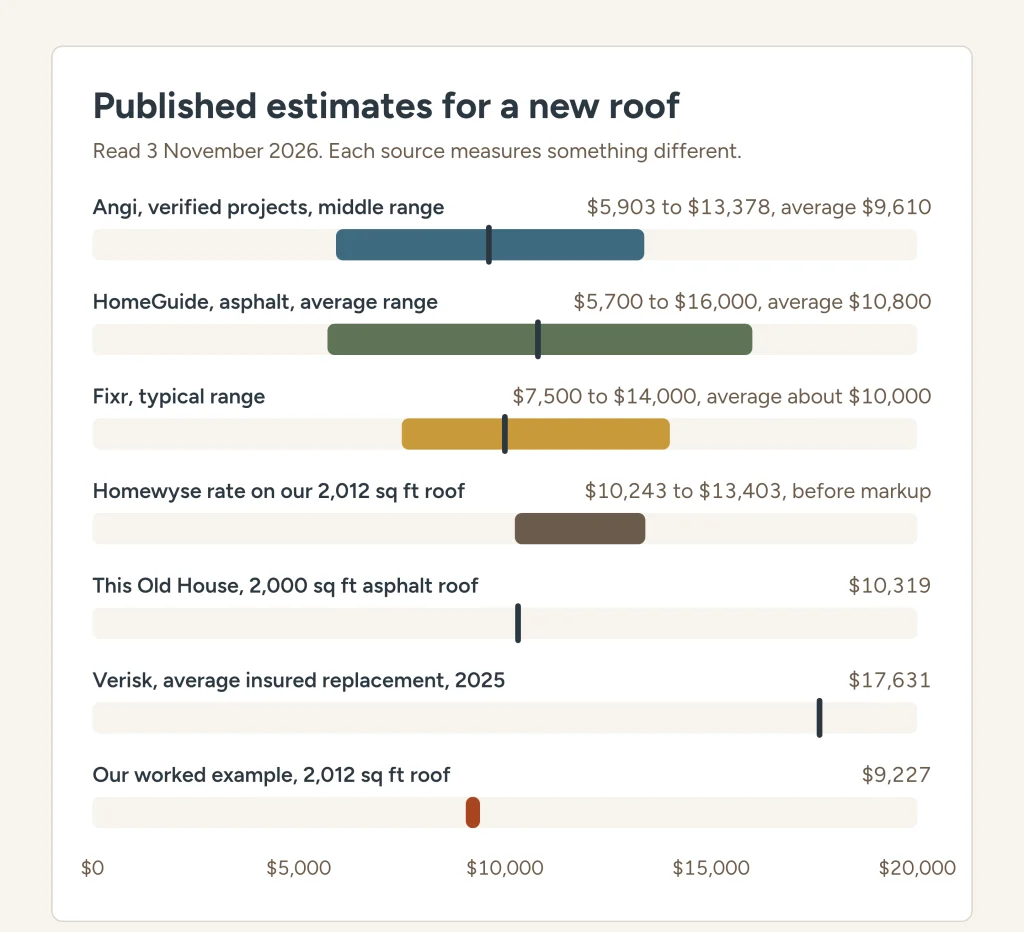
Angi puts the 2026 national average for a roof replacement at $9,610, with most jobs between $5,903 and $13,378, from 32,999 projects on its platform (updated 22 October 2026). HomeGuide’s average range for an asphalt shingle roof is $5,700 to $16,000 (7 November 2025). Insurance claims run higher: Verisk’s average for an insured roof replacement in 2025 was $17,631. Our own build-up for a 2,012 sq ft roof on a 1,800 sq ft footprint comes to $9,227, or $4.58 per square foot of roof. The calculator on this page lets you change every input that drives that number. More roof and gutter costs are in our roofing guides.
CostPlain has no crew and gets no quotes. The figures here are estimates built from public data, not prices. A licensed local roofer and your building department decide what your roof needs.
Published estimates
We found no government survey of what homeowners pay for a new roof. What exists is an insurance data firm’s claims average and cost guides, most of which earn money by passing your details to contractors. Here they are side by side with what each one measures. We don’t average them.
| Source | Figure | Date | What it measures |
|---|---|---|---|
| Verisk | Average $17,631 | 2025 data, released 29 May 2026 | Average cost of insured residential roof replacements, from claims data, which the release ties to wind and hail. It doesn’t say whether deductibles or partial jobs are included |
| Angi | Average $9,610; most pay $5,903 to $13,378; $420 to $46,000 overall | Updated 22 Oct 2026 | 32,999 “verified projects”; Angi says its figures come from surveys of its customers plus outside research. All materials and roof sizes. A site that sells leads to contractors |
| HomeGuide | Average $10,800; $5,700 to $16,000 average range; $300 to $600 per square | Page dated 7 Nov 2025 | Asphalt shingles, from “research and project costs reported by HomeGuide members”. A site that sells leads to contractors |
| Fixr | Average about $10,000; typical $7,500 to $14,000; $3.75 to $11 per sq ft | Updated 4 Feb 2026 | Built from “pricing databases, licensed contractors, and industry experts” |
| This Old House | $10,319 for a 2,000 sq ft asphalt roof ($5.16 per sq ft) | Updated 7 Oct 2026 | Cost data from Homewyse, the page says |
| Homewyse | $5.09 to $6.66 per sq ft, starting price | May 2026 | Commercial estimator. Easy site conditions; excludes contractor markup (it says add 13% to 22% if a general contractor runs the job), permits and sales tax |
| RoofingCalculator | Asphalt $3.40 to $5.95 per sq ft; $5,840 to $10,100 for 1,700 sq ft | No date shown | Table figures for a 1,700 sq ft roof; no other method stated |
One more figure gets quoted a lot. The Remodeling 2025 Cost vs. Value Report puts an asphalt roof replacement at $31,871 as a national average. That is a modeled price for one defined job: tearing off to bare sheathing and laying 30 squares (3,000 sq ft) of shingles on a rectangular hip roof, with new underlayment, drip edge and flashing, custom flashing at two average-size skylights and a custom cap at the vented ridge. It is a bigger, more involved roof than most of the averages above describe. © 2025 Zonda Media, a Delaware Corporation. Complete data from the Remodeling 2025 Cost vs. Value Report can be downloaded free at www.costvsvalue.com.
Two cautions. Inch Calculator’s page is headlined with 2026 prices and a $14,000 average for a 2,000 sq ft roof, but it showed an update date of 18 July 2023 when we read it. We could not open Forbes Home’s guide.
Our worked estimate
The published numbers don’t show their working, so we built one roof from the bottom up, the way we describe in how we estimate costs. The example house is a single-story, 30 by 60 ft gable home, 1,800 sq ft including the overhangs, with a 6 in 12 roof and one old layer of shingles.
Materials are shelf prices at Lowe’s on 3 November 2026, as shown for the Presque Isle, Maine store. Prices vary by store and season, so treat them as a dated example, not a national price.
| Line | Working | Cost |
|---|---|---|
| Shingles | 20.12 squares + 10% waste = 22.14 squares; × 3 bundles = 67 bundles × $47.98 (architectural, 33.3 sq ft a bundle) | $3,214.66 |
| Synthetic underlayment | 3 rolls of 1,000 sq ft × $58.18 | $174.54 |
| Ice and water barrier at the eaves | 120 ft × 3 ft + 10% = 396 sq ft; 3 rolls of 150 sq ft × $74.98 | $224.94 |
| Starter strip | 187 ft of eaves and rakes; 2 bundles of 105 ft × $48.08 | $96.16 |
| Ridge cap | 60 ft; 3 bundles of 25 ft × $63.98 | $191.94 |
| Drip edge | 187 ft; 19 galvanized pieces × $16.98 | $322.62 |
| Ridge vent | 60 ft; 15 four-foot pieces × $12.98 | $194.70 |
| Nails | 1 box of 7,200 coil nails × $56.28 | $56.28 |
| Deck repair | 3 sheets of 7/16 in OSB × $13.62 (our assumption for rot found at tear-off) | $40.86 |
| Flashing, pipe boots, sealant | Allowance, our assumption | $300.00 |
| Materials | Before sales tax | $4,816.70 |
Labor. The median hourly wage for roofers was $26.65 in May 2025 (BLS). Construction employers paid on average $51.96 an hour in total compensation for every $36.13 in wages in June 2026 (BLS), so we multiply the wage by 1.44 to cover benefits and payroll taxes: $38.38 an hour. No public source we found gives the hours a roof takes, so these are our assumption: 2 labor-hours a square to dry in and shingle, 1 to tear off a layer and clean up, and half an hour per deck sheet. That is 20.12 × 3 + 1.5 = 61.9 labor-hours, about two days for a crew of four. Labor: 61.87 labor-hours × $38.376 = $2,374.47.
Disposal. IKO, a shingle maker, puts torn-off laminated shingles at about 240 pounds a square with underlayment and nails. Our roof is about 2.4 tons, inside one 20-yard container. The City of Searcy, Arkansas charges $373 plus tax for one, with 4 tons included and $40 a ton over (its page shows a date of 8 August with no year): $373. Landfill fees alone vary a lot; Winnebago County, Wisconsin charges $59 a ton for clean shingles in 2026.
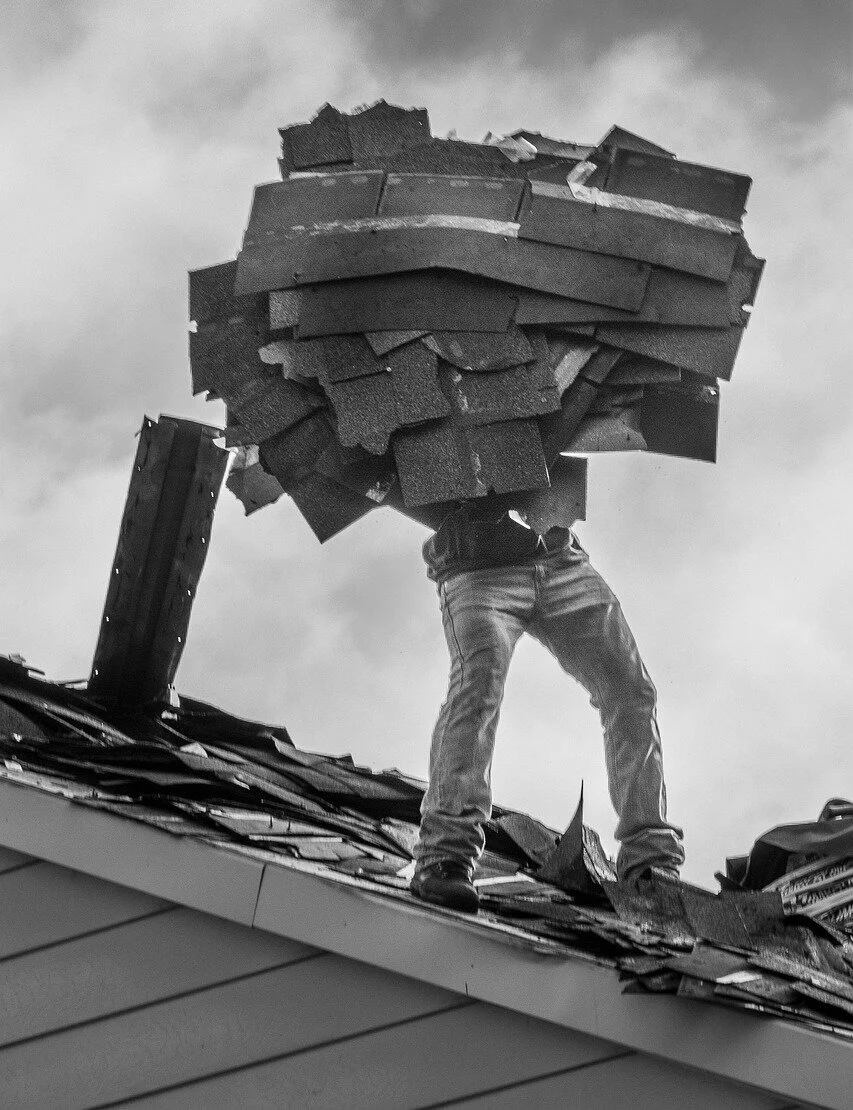
Overhead and profit: 20%, our assumption. It covers the contractor’s office, insurance, trucks, sales time and margin. For comparison, a 2013 claims bulletin from FEMA’s flood insurance program calls 10% overhead plus 10% profit the typical charge when a general contractor has to coordinate several trades. On $7,564.17 of materials, labor and disposal that is $1,512.83.
Permit: $150, our placeholder. Fees are set locally. Hutchinson, Minnesota charges $70 plus a state surcharge for a house re-roof in 2026; many cities charge by the value of the job instead.
Total: $4,816.70 + $2,374.47 + $373 + $1,512.83 + $150 = $9,227.00. That is $4.58 per square foot of roof, or $458 a square. Sales tax is off by default; at 7% it would add about $405 with the markup on it.
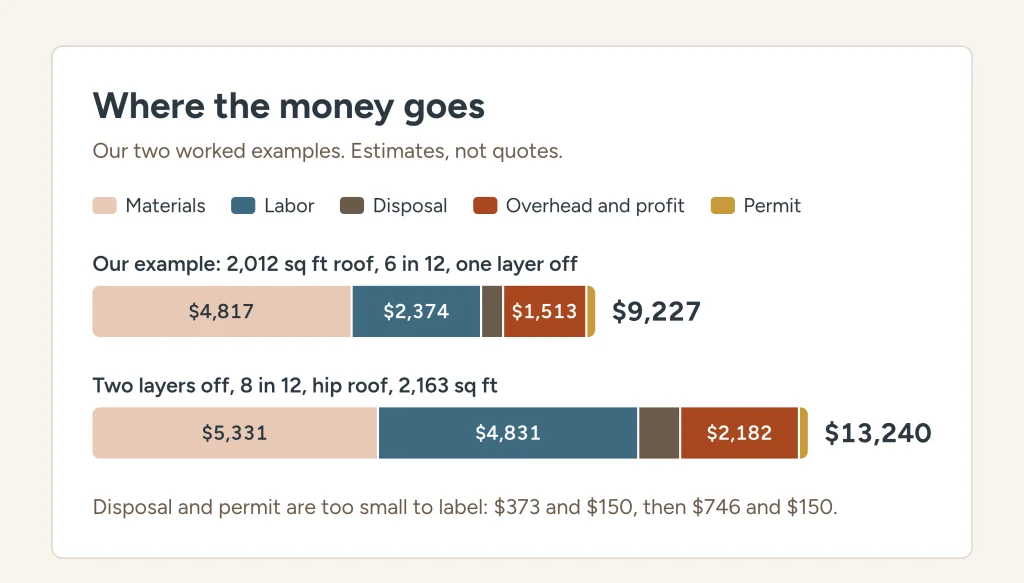
The second bar is the same kind of house with a hip roof (180 ft of eaves, four 23.5 ft hips and a 30 ft ridge for 124 ft of cap, 30 ft of ridge vent, 12% waste), an 8 in 12 pitch and two layers to strip. Labor-hours more than double, to 126, and it needs two dumpsters. Materials come to $5,331, labor $4,831, disposal $746 and overhead and profit $2,182; with the $150 permit the total is $13,240.
How the calculator works
Roofers price by the square, 100 sq ft of roof surface. The roof is bigger than the footprint because it slopes. Pitch is written as inches of rise per foot of run, so a 6 in 12 roof rises 6 inches every 12 (the same notation OSHA’s roofing rules use). The slope factor is the square root of 1 + (rise ÷ 12)².
| Pitch | Slope factor | Roof area on a 1,800 sq ft footprint |
|---|---|---|
| 3 in 12 | 1.031 | 1,855 sq ft |
| 4 in 12 | 1.054 | 1,897 sq ft |
| 6 in 12 | 1.118 | 2,012 sq ft |
| 8 in 12 | 1.202 | 2,163 sq ft |
| 10 in 12 | 1.302 | 2,343 sq ft |
| 12 in 12 | 1.414 | 2,546 sq ft |
From there the calculator works out:
- Bundles = roof squares × (1 + waste) × bundles per square, rounded up. Three bundles don’t always make a full square: the Owens Corning Oakridge data sheet gives 98.4 sq ft per three bundles, so the waste allowance absorbs the gap.
- Edge and ridge parts from the lengths you enter: starter and drip edge along eaves and rakes, cap along ridges and hips, vent along the ridge, ice and water barrier along the eaves and valleys. Each is rounded up to whole rolls or pieces at the Lowe’s prices above.
- Labor-hours = squares × (install hours + layers × tear-off hours) × steep factor × shape factor + deck sheets × 0.5. The steep factor is 1.25 at 8 or 9 in 12 and 1.5 at 10 in 12 and up; the shape factor is 1.15 for a hip roof or a few valleys and 1.3 for a cut-up roof. All are our assumption.
- Labor = labor-hours × wage × 1.44.
- Disposal = containers × fee, at 240 lb a square per layer and 4 tons a container.
- Total = (materials with tax + labor + disposal) × (1 + overhead and profit) + permit.
Our labor line is the least certain number on this page. Change the hours and see what happens: 3 install hours a square instead of 2 adds about $930 to the example. Moving overhead and profit from 20% to 30% adds about $760.
Why the estimates differ
Verisk’s $17,631 and Cost vs. Value’s $31,871 are not two opinions on the same roof. Verisk averages insurance claims, so its roofs are mostly storm-damaged, and the release doesn’t break them down by material or size. It says wind and hail drive claim costs, and it reports roofing materials up 1.48% and roofer labor up 0.79% in 2025, with materials up 10.37% in Nevada and down 15.80% in New Hampshire. Cost vs. Value models one large, specified job. Its methodology says its local building cost data come from Verisk too, so the gap is mostly scope. Scale our example house up to 30 squares with the hip-roof labor factor and the calculator gives about $13,190, still well below $31,871. Its job includes custom flashing at two skylights, and the report doesn’t say whether permits, overhead or profit are in the figure.
The cost guides measure what was billed. Angi’s and HomeGuide’s figures come from projects reported in their networks, across many roof sizes and, for Angi, all materials. They include the roofer’s markup. Homewyse’s rate leaves the markup out.
Our build-up is lean on labor. Fixr, RoofingCalculator and This Old House put labor at 40% to 65% of a roofing bill. In our example it is under a third of the direct cost. Three reasons:
- The BLS wage is the median for employees. It leaves out self-employed roofers, and it is a wage, not what a firm bills.
- The 1.44 uplift is an average across all construction jobs, not roofing. We found no public figure for how much more a roofer’s insurance costs.
- The hours are our assumption. Angi says to expect to pay each worker $40 to $90 an hour; our loaded cost is $38.38 before markup, $46.05 after.
So if a quote’s labor and markup lines come to more than ours, that alone doesn’t make it wrong. A quote far below the published ranges deserves questions too: what is left out?
What moves the price
- Roof area and pitch. A 12 in 12 roof has 41% more surface than its footprint, and HomeGuide notes that pitches over 6 in 12 need extra safety precautions and more labor.
- Layers. Each extra layer adds tear-off hours and tons of debris. Whether new shingles may go over an old layer is set by your local building code, so ask the building department, not just the roofer.
- Rotten decking. Damaged sheathing often isn’t found until the old roof is off. Ask for a price per sheet in writing before work starts.
- Shape. Valleys, dormers, chimneys and skylights mean cutting and flashing. Chimney work is often priced separately; see our guide to chimney repair prices.
- Shingle grade. The two architectural lines we priced at Lowe’s on 3 November 2026 were $45.97 and $47.98 a bundle. Premium lines cost more: at Menards the same day, before its mail-in rebate, Owens Corning’s Duration Designer was $49.99 a bundle against $44.97 for its Oakridge.
- Ice barrier and ventilation. Many cold-climate areas require ice barrier at the eaves; your building department decides how much.
- Material. Metal, tile and slate are different jobs with different crews; our metal roof cost comparison covers metal.
- Gutters. Often replaced at the same time but priced separately; try our gutter cost calculator.
What a quote should list
Ask every roofer to price the same scope, line by line, so you can compare them with each other and with the calculator:
- Roof area in squares, and the waste allowance
- Shingle maker, product line and color; the nails per shingle. The Oakridge data sheet, for example, gives a 110 mph wind warranty with 4 nails and 130 mph only with 6 nails and the maker’s starter shingles at the eaves and rakes
- Tear-off of how many layers, and disposal
- Underlayment type, and where ice and water barrier goes
- Drip edge, flashing (new or reused), pipe boots and vents
- Price per sheet of replaced decking, and per foot of fascia
- Permit, who pulls it, and the inspection
- Workmanship warranty from the roofer, and any maker’s warranty, in writing
- Payment schedule, start date and cleanup, including magnetic sweeps for nails
Red flags, insurance and safety
Door-to-door sellers after a storm. Under the FTC’s Cooling-Off Rule, a sale of $25 or more made at your home generally comes with a written right to cancel within three business days. There is a narrow exception for a genuine emergency that you started yourself and waive in your own handwriting, so be wary of anyone pressing you to sign such a waiver. Pressure to sign the same day, a large cash deposit, or an offer to “handle the insurance” are reasons to slow down.
Insurance. Read your policy’s roof terms before a claim. As the DC insurance regulator explains, replacement cost value pays for new materials of similar kind and quality, minus the deductible, while actual cash value pays the roof’s depreciated value: about half, in its example of a 10-year-old roof depreciated 50%. Insurance terms vary by policy and state; this is not claim advice.
Grants for stronger roofs. Louisiana’s Fortify Homes Program grants up to $10,000 in eligible parishes toward a roof built to the FORTIFIED standard of the Insurance Institute for Business & Home Safety. The standard requires a sealed roof deck, ring-shank nails and stronger edges. Grants aren’t paid for roofs fortified before a grant is awarded, and lottery registration was closed when we checked. Ask your state insurance department whether anything similar exists where you live.
Old attic insulation. If the attic has loose, pebble-like vermiculite, EPA says to assume it contains asbestos and not disturb it. Tell the roofer before any deck boards come off.
Lead paint. If the house was built before 1978 and the job disturbs painted fascia, soffits or trim, EPA’s Renovation, Repair and Painting rule requires anyone paid to do that work to be certified, including sole proprietors. Ask for the firm’s certification.
Stay off the roof. Roofers are required to use fall protection for a reason: falls are the leading cause of death in residential construction (OSHA). Look at your roof from the ground or with binoculars, or ask the roofer for photos; don’t climb up.
Repair or replace?
Not every leak needs a new roof. Verisk’s average insured roof repair in 2025 was $4,699, about a quarter of its replacement average, though a claims average says little about a small leak. Our roof repair cost guide covers when patching makes sense. If you aren’t sure what shape the roof is in, an independent roof inspection from someone who isn’t quoting the replacement is cheap next to either.
What the calculator leaves out
- Other materials. It prices asphalt shingles only.
- Structure. Sagging rafters, new trusses or a full new deck need a site visit, and sometimes an engineer.
- Skylights, chimneys, gutters and fascia beyond the flashing allowance.
- Your local prices. Materials are one store’s shelf prices on one day, the wage is a national median, and dumpster and permit fees are single-city examples. Replace them with local figures where you can.
- Financing and price changes after the dates we read the prices.
This page is general information, not professional, legal, insurance or financial advice. All figures are estimates; a licensed local roofer and your local building department decide what your roof needs.
Sources checked on 3 November 2026.
Formulas and sources
- Slope factor: Slope written as rise in 12, vertical to horizontal (29 CFR 1926.500); roof area by the Pythagorean theorem
- Roof area: Slope written as rise in 12, vertical to horizontal (29 CFR 1926.500); roof area by the Pythagorean theorem
- Roof area in squares: Slope written as rise in 12, vertical to horizontal (29 CFR 1926.500); roof area by the Pythagorean theorem
- Squares to buy, with waste: CostPlain: how we estimate (our assumption, shown and editable)
- Shingle bundles: Owens Corning Oakridge data sheet: 64 shingles and 98.4 sq ft per 3 bundles; 4 or 6 nails
- Shingles: Lowe's, roofing listings seen 3 Nov 2026 (Presque Isle, Maine store shown)
- Underlayment: Lowe's, roofing listings seen 3 Nov 2026 (Presque Isle, Maine store shown)
- Ice and water barrier: Lowe's, roofing listings seen 3 Nov 2026 (Presque Isle, Maine store shown)
- Starter strip: Lowe's, roofing listings seen 3 Nov 2026 (Presque Isle, Maine store shown)
- Ridge cap: Lowe's, roofing listings seen 3 Nov 2026 (Presque Isle, Maine store shown)
- Drip edge: Lowe's, roofing listings seen 3 Nov 2026 (Presque Isle, Maine store shown)
- Ridge vent: Lowe's, roofing listings seen 3 Nov 2026 (Presque Isle, Maine store shown)
- Nails: Lowe's, roofing listings seen 3 Nov 2026 (Presque Isle, Maine store shown)
- Deck sheets: Lowe's, roofing listings seen 3 Nov 2026 (Presque Isle, Maine store shown)
- Materials with tax: Lowe's, roofing listings seen 3 Nov 2026 (Presque Isle, Maine store shown)
- Steep-roof labor factor: CostPlain: how we estimate (our assumption, shown and editable)
- Labor-hours: CostPlain: how we estimate (our assumption, shown and editable)
- Employer cost per labor-hour: BLS Employer Costs for Employee Compensation, June 2026, construction (Table 4)
- Labor: BLS Occupational Outlook Handbook: Roofers, median pay May 2025
- Tear-off debris: IKO (shingle maker): laminate shingles about 240 lb per square torn off, with underlayment and nails (Aug 2023)
- Dumpster and disposal: City of Searcy, Arkansas: 20-yard roll-off $373 plus tax, 4 tons included
- Materials, labor and disposal: CostPlain: how we estimate (our assumption, shown and editable)
- Overhead and profit: FEMA NFIP Bulletin W-13064: 10% overhead plus 10% profit is the typical charge (2013)
- Estimated total: CostPlain: how we estimate (our assumption, shown and editable)
- Per square foot of roof: CostPlain: how we estimate (our assumption, shown and editable)
- Per square (100 sq ft): CostPlain: how we estimate (our assumption, shown and editable)
- Employer cost per $1 of wages, construction (51.96 / 36.13) (1.44, as of 2026-11-03): BLS Employer Costs for Employee Compensation, June 2026, construction (Table 4)
- Synthetic underlayment, 1,000 sq ft roll, Lowe's (58.18, as of 2026-11-03): Lowe's, roofing listings seen 3 Nov 2026 (Presque Isle, Maine store shown)
- Underlayment roll coverage, sq ft (1000, as of 2026-11-03): Lowe's, roofing listings seen 3 Nov 2026 (Presque Isle, Maine store shown)
- Ice and water barrier, 150 sq ft roll, Lowe's (74.98, as of 2026-11-03): Lowe's, roofing listings seen 3 Nov 2026 (Presque Isle, Maine store shown)
- Ice and water roll coverage, sq ft (150, as of 2026-11-03): Lowe's, roofing listings seen 3 Nov 2026 (Presque Isle, Maine store shown)
- Ice and water width in valleys, ft (one 36 in roll width) (3, as of 2026-11-03): Lowe's, roofing listings seen 3 Nov 2026 (Presque Isle, Maine store shown)
- Starter strip bundle, 105 lin ft, Lowe's (48.08, as of 2026-11-03): Lowe's, roofing listings seen 3 Nov 2026 (Presque Isle, Maine store shown)
- Starter strip per bundle, lin ft (105, as of 2026-11-03): Lowe's, roofing listings seen 3 Nov 2026 (Presque Isle, Maine store shown)
- Hip and ridge cap bundle, 25 lin ft, Lowe's (63.98, as of 2026-11-03): Lowe's, roofing listings seen 3 Nov 2026 (Presque Isle, Maine store shown)
- Ridge cap per bundle, lin ft (25, as of 2026-11-03): Lowe's, roofing listings seen 3 Nov 2026 (Presque Isle, Maine store shown)
- Galvanized drip edge, 10.2 ft piece, Lowe's (16.98, as of 2026-11-03): Lowe's, roofing listings seen 3 Nov 2026 (Presque Isle, Maine store shown)
- Drip edge per piece after overlap, ft (our assumption) (10, as of 2026-11-03): CostPlain: how we estimate (our assumption, shown and editable)
- Ridge vent, 4 ft piece, Lowe's (12.98, as of 2026-11-03): Lowe's, roofing listings seen 3 Nov 2026 (Presque Isle, Maine store shown)
- Ridge vent per piece, ft (4, as of 2026-11-03): Lowe's, roofing listings seen 3 Nov 2026 (Presque Isle, Maine store shown)
- Coil roofing nails, 7,200 per box, Lowe's (56.28, as of 2026-11-03): Lowe's, roofing listings seen 3 Nov 2026 (Presque Isle, Maine store shown)
- Nails per box (7200, as of 2026-11-03): Lowe's, roofing listings seen 3 Nov 2026 (Presque Isle, Maine store shown)
- Nails per square: 64 shingles x 4 nails, plus starter and cap (our rounding up) (320, as of 2026-11-03): Owens Corning Oakridge data sheet: 64 shingles and 98.4 sq ft per 3 bundles; 4 or 6 nails
- 7/16 in OSB sheet, 4 x 8 ft, Lowe's (13.62, as of 2026-11-03): Lowe's, roofing listings seen 3 Nov 2026 (Presque Isle, Maine store shown)
- Labor-hours to replace one deck sheet (our assumption) (0.5, as of 2026-11-03): CostPlain: how we estimate (our assumption, shown and editable)
- Torn-off weight per square per layer, laminate shingles, lb (240, as of 2026-11-03): IKO (shingle maker): laminate shingles about 240 lb per square torn off, with underlayment and nails (Aug 2023)
- Tons included per 20-yard container (4, as of 2026-11-03): City of Searcy, Arkansas: 20-yard roll-off $373 plus tax, 4 tons included
Sources
- Verisk: Roofing Reality Check, 2026 U.S. Roof Report release (29 May 2026)
- Angi: How Much Does Roof Replacement Cost? (updated 22 October 2026, sells leads to contractors)
- HomeGuide: Roof replacement cost (7 November 2025, sells leads to contractors)
- Fixr: Roof replacement cost (updated 4 February 2026)
- This Old House: New roof cost (updated 7 October 2026)
- Homewyse: Cost to install an asphalt shingle roof (May 2026, commercial estimator)
- RoofingCalculator: Roof replacement cost (undated)
- Remodeling 2025 Cost vs. Value Report, national figures (Zonda Media)
- Remodeling 2025 Cost vs. Value Report: methodology
- BLS Occupational Outlook Handbook: Roofers (May 2025 wages, modified 14 September 2026)
- BLS Employer Costs for Employee Compensation, June 2026, Table 4
- IKO: Dumpster size for roofing (15 August 2023)
- City of Searcy, Arkansas: Dumpster and roll-off bin rentals
- Winnebago County Solid Waste: 2026 tipping fee schedule (effective 1 January 2026)
- FEMA NFIP Bulletin W-13064: Allowance for Overhead and Profit (2013)
- City of Hutchinson, Minnesota: 2026 fee schedule (amended 13 January 2026)
- 29 CFR 1926.500: definitions, slope as rise in 12 (eCFR)
- Owens Corning Oakridge shingles data sheet
- 16 CFR Part 429: FTC Cooling-Off Rule (eCFR)
- DC Department of Insurance, Securities and Banking: Roof damage claims
- Louisiana Department of Insurance: Fortify Homes Program
- EPA: Protect your family from asbestos-contaminated vermiculite insulation (updated 17 April 2026)
- OSHA: Fall Protection in Residential Construction
- EPA: Renovation, Repair and Painting Program (updated 17 June 2026)
- Lowe's: architectural shingles and roofing accessories, prices seen 3 November 2026
- Menards: architectural shingles, prices seen 3 November 2026