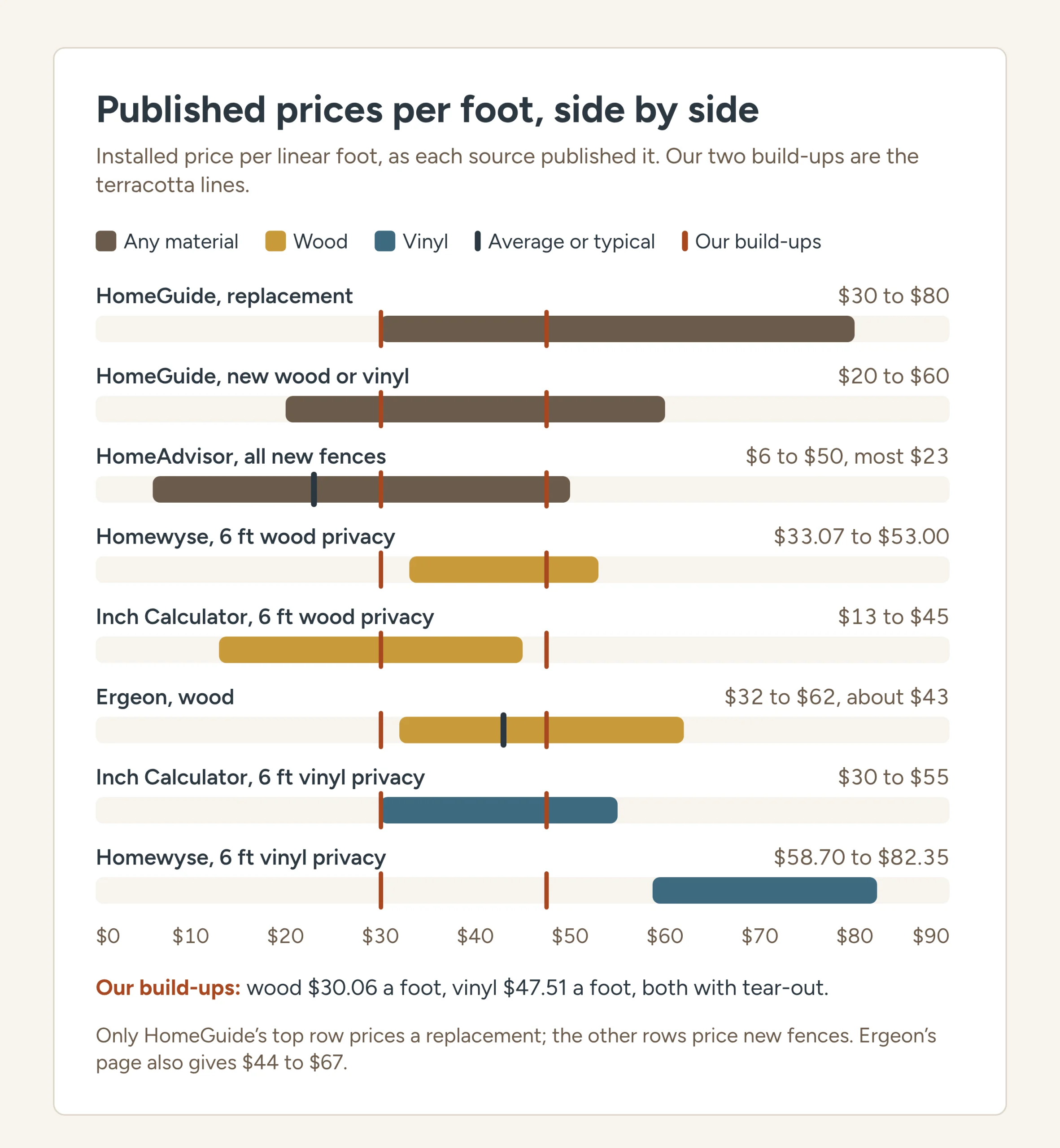
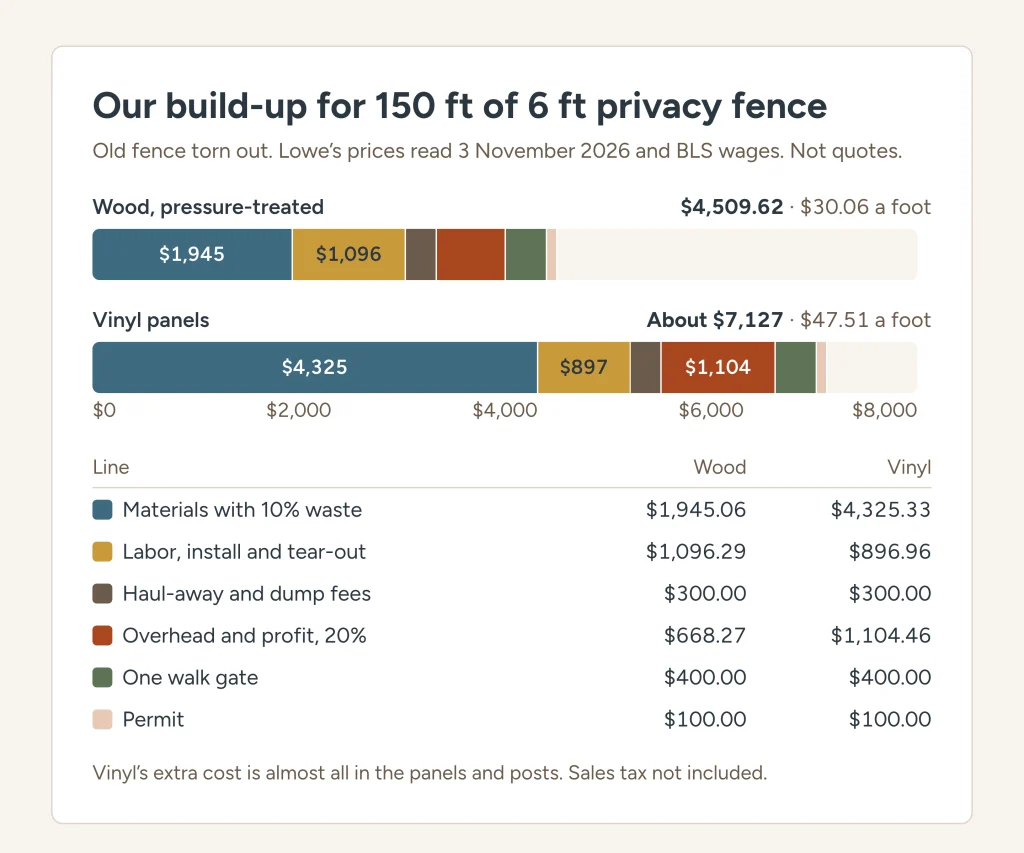
Replacing a typical back-yard fence costs a few thousand dollars, and published estimates disagree widely on the price per foot. HomeGuide puts a fence replacement at $30 to $80 per linear foot (February 2026). HomeAdvisor gives an average of $3,277 for a fence installation (June 2026). Our own build-up for 150 feet of 6 ft wood privacy fence, with the old fence torn out and hauled away, comes to about $4,510, or $30 a foot. The same yard in vinyl panels comes to about $7,130. The calculator on this page runs the same arithmetic on your fence, and you can change every price and hour count. For driveways, siding and other outside work, see our exterior and finishes guides.
The sections below set the published figures side by side, show where each line of our estimate comes from, and explain why published figures for a wood or vinyl fence run from $13 to about $82 a foot. CostPlain has no crew and sells no fences: these are estimates built from public data, not quotes.
Published estimates side by side
No government agency publishes installed fence prices. The figures below come from commercial cost guides, most of which also sell contractor leads, and from one fence installer. They are published estimates, not measured prices, and we have not averaged them, because they measure different things.
| Source and date | Figure | What it measures |
|---|---|---|
| HomeGuide, 3 Feb 2026 | Replacement $30 to $80 per ft; new wood or vinyl fence $20 to $60 per ft; $4,000 to $12,000 for 200 ft | Lead-generation site. Says it draws on estimates homeowners get from contractors. Lists old fence removal separately at $10 to $20 per ft |
| HomeAdvisor, updated 20 Jun 2026 | Average $3,277; typical $1,860 to $4,845; $6 to $50 per ft, most paying $23 | Lead-generation site. Says its pricing comes from surveys of over 30,000 customers about their project costs. Covers new fences of every material, so cheap materials and short runs sit in the same average. Removal extra at $3 to $5 per ft |
| Homewyse, May 2026 | 6 ft wood privacy fence from $33.07 to $53.00 per ft | Commercial estimator, national average, priced from non-discounted retail materials and basic mid-range labor. A basic install with posts in concrete at 8 ft spacing. Its sample job is 27 ft. Leaves out removal, permits, sales tax and any general contractor’s markup |
| Inch Calculator, page dated 7 Jul 2023 but titled with 2026 prices | Typical job $2,000 to $4,500; 6 ft wood privacy $13 to $45 per ft; 6 ft vinyl privacy $30 to $55 per ft | Commercial calculator site. Adds 10% extra material for waste; excludes tax, permits and inspections. Removal $350 to $600 as an option |
| Ergeon, updated 1 Jul 2026 | Wood fence about $43 per ft, most $32 to $62 | A fence installer’s figures from what it says are 41,420 installed wood fences. The same page also gives $54 a foot, range $44 to $67, so treat it with care |
Two things stand out. First, only HomeGuide prices a replacement as such, and it is the highest figure in the table: tearing out the old fence costs money that a new-fence average leaves out. Second, HomeAdvisor’s page summary describes its $1,860 to $4,845 range as “per linear foot”, which cannot be right next to its own $6 to $50 a foot. Read the detail of any range, not just the headline.
Our build-up for a 150 ft wood fence
To see what sits inside those ranges, we priced one common job line by line: 150 feet of 6 ft pressure-treated wood privacy fence on three sides of a back yard, with dog-ear pickets on three rails, posts every 8 feet in concrete, one walk gate, and the old fence torn out. Material prices are Lowe’s online prices for one store, read on 3 November 2026; prices vary by store and week. Our estimating method explains the approach used on every CostPlain page.
What gets counted
- Sections: 150 ÷ 8 = 18.75, rounded up to 19, plus one extra for each extra side because each side ends in its own short section: 21 sections.
- Posts: one more than the sections: 22.
- Pickets: 150 feet is 1,800 inches; ÷ 5.5 inches per picket = 327.3, so 328 pickets, edge to edge with no gaps.
- Rails: 21 sections × 3 rails = 63 boards, 2x4x8.
- Concrete: 2 bags per post × 22 posts = 44 bags of 50 lb. Quikrete’s data sheet says each 50 lb bag of its fast-setting mix yields about 0.375 cubic feet, and that two bags set a 3-inch post in a 9-inch hole 30 inches deep. Our 4×4 posts are 3.5 inches wide, and the same sheet suggests a hole about three times the post’s width, so a real job may need more than two bags a post; change the count in the calculator.
| Line | Working | Cost |
|---|---|---|
| Pickets, 5/8 in x 5-1/2 in x 6 ft, pressure-treated | 328 × $2.18 | $715.04 |
| Rails, 2x4x8 pressure-treated, above-ground rating | 63 × $5.84 | $367.92 |
| Posts, 4x4x8 pressure-treated, ground-contact rating | 22 × $11.78 | $259.16 |
| Concrete mix, 50 lb bags | 44 × $7.98 | $351.12 |
| Nails, screws and brackets | 150 ft × $0.50, our assumption | $75.00 |
| Waste and spares | 10% of $1,768.24, our assumption | $176.82 |
| Materials | $1,945.06 | |
| Labor: install | 16 labor hours per 100 ft over 150 ft = 24 hours, our assumption | |
| Labor: tear-out | 6 labor hours per 100 ft over 150 ft = 9 hours, our assumption | |
| Labor | 33 hours × $23.07 × 1.44 ($33.22 an hour) | $1,096.29 |
| Haul-away and dump fees | Our assumption | $300.00 |
| Overhead and profit | 20% of $3,341.35, our assumption | $668.27 |
| One walk gate, installed | Ergeon’s $399 average, rounded | $400.00 |
| Permit | Placeholder, our assumption | $100.00 |
| Estimated total | $30.06 per foot | $4,509.62 |
The concrete price is the top Lowe’s result for fast-setting 50 lb mix that day; the listing did not name the variant, and the basic Quikrete mix next to it was $4.08 a bag. Sales tax is not in the table; Homewyse and Inch Calculator leave it out too. Add your local rate in the calculator.
Where the labor figure comes from
Wage. The median hourly wage for fence erectors (occupation 47-4031) was $23.07 in May 2025, according to the BLS national wage survey. That is what half of employed fence erectors earn more than and half less, before benefits. It is a small group, about 24,480 workers, and BLS counts employees only, not self-employed installers. Pay for residential crews in your area may differ, so enter a local figure if you have one.
Employer costs. Construction employers paid on average $51.96 an hour in total compensation for every $36.13 in wages in June 2026 (BLS), so we multiply the wage by 1.44 to cover benefits and payroll taxes. That gives $33.22 an hour, before the contractor’s overhead and profit.
Hours. We found no primary source for fence labor hours, so these are our assumption. We use 16 labor hours per 100 feet to set posts and build a wood privacy fence board by board, the top of the 13 to 16 hours that HomeGuide gives for picket or privacy fences. Tear-out is 6 hours per 100 feet, because pulling posts with concrete footings is slow work. Together that is 22 hours per 100 feet, the top of HomeGuide’s 19 to 22 hours for fence replacements. We pay every hour at one worker’s wage. HomeGuide does not say whether its hours are for one installer or a whole crew; if they are for a crew of two, labor doubles, and the wood estimate rises by about $1,316 after overhead and profit, to about $5,825 or $39 a foot. Enter your own hours if a quote names crew size and days.
Overhead and profit: 20%, our assumption. It covers the contractor’s office, insurance, vehicles and tools, time spent on estimates and permits, and margin. Insurance estimates often use 10% overhead plus 10% profit; FEMA’s flood program calls this the typical charge. Real quotes vary, so change it.
The calculator’s formula
- Sections = length ÷ post spacing, rounded up, + (sides − 1). Posts = sections + 1.
- Wood materials = pickets × picket price + sections × rails × rail price + posts × post price + length × hardware per foot.
- Vinyl materials = sections × panel price + posts × vinyl post price.
- Other materials = length × your materials price per foot.
- Concrete = posts × bags per post × bag price, added to every type.
- Materials with waste and tax = (materials + concrete) × (1 + waste %) × (1 + tax %).
- Labor = (install hours + tear-out hours, each per 100 ft × length ÷ 100) × wage × 1.44.
- Total = (materials + labor + disposal) × (1 + overhead and profit %) + gates + permit.
Gates and the permit are added after overhead and profit, because the gate figure is already an installed price and a permit fee is passed through. The calculator counts the gate opening as fence, which slightly overstates materials.
Vinyl, chain link and other fences
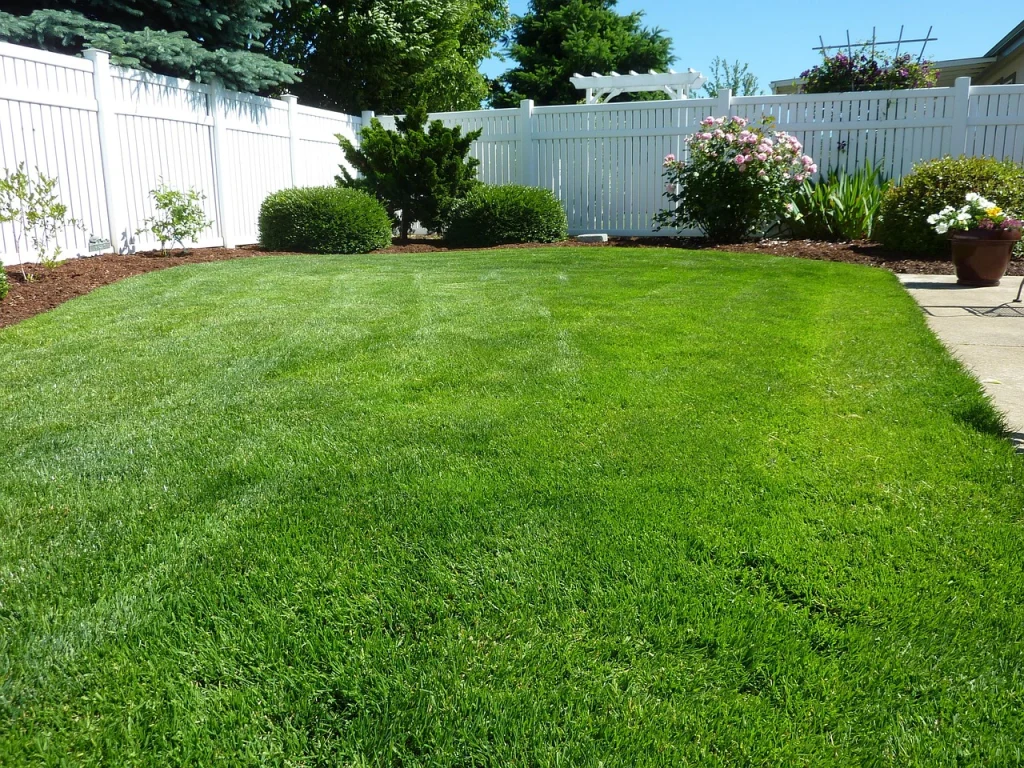
Vinyl. The same 150 ft yard in white vinyl privacy panels needs 21 panels at $132.16 (a 6 ft x 8 ft panel at Lowe’s, 3 November 2026) and 22 matching 9 ft line posts at $36.62 (end, corner and gate posts can cost more). With the same concrete, waste allowance, tear-out and disposal, and 12 labor hours per 100 feet to install (our assumption: panels slide into routed posts, so the crew is not fixing boards one by one), the estimate is:
- Materials: $2,775.36 + $805.64 + $351.12 = $3,932.12, plus 10% = $4,325.33
- Labor: 27 hours × $23.07 × 1.44 = $896.96
- Disposal $300; overhead and profit 20% = $1,104.46; gate $400; permit $100
- Total: about $7,127, or $47.51 a foot
Vinyl’s extra cost is almost all in the panels and posts, which cost more than twice the wood parts. For comparison, Homewyse puts a 6 ft vinyl privacy fence at $58.70 to $82.35 a foot (May 2026), HomeGuide puts vinyl at $30 to $60, and Inch Calculator puts 6 ft vinyl privacy at $30 to $55. We used one of the cheaper panels listed; others in the same search ran up to $285.
Chain link and other fences. A chain link fence has fabric, top rail, line and terminal posts, tension bars, bands and ties, and the parts list depends on the layout, so the calculator doesn’t price it part by part. Choose “Other” and enter your own materials price per foot. As reference points, Homewyse puts a 6 ft galvanized chain link fence at $29.08 to $44.84 a foot installed (May 2026), and HomeGuide gives $10 to $40. A 50 ft roll of 11.5-gauge galvanized fabric was listed at $135 to $162 at Lowe’s on 3 November 2026, depending on height.
Why the estimates differ
Our $30 a foot sits at the bottom of HomeGuide’s $30 to $80 replacement range. Here is why, and what each source includes or leaves out:
- Tear-out. In our build-up, tearing out and hauling away 150 feet comes to $598.99, or about $4 a foot before overhead. HomeAdvisor’s $3 to $5 a foot is close to that; HomeGuide’s $10 to $20 a foot is two and a half to five times higher. Inch Calculator’s $350 to $600 is a flat job price. A replacement quote that doesn’t name removal either includes it or will charge it later: ask.
- Job size. Fixed costs (driving out, delivery, layout, a minimum labor charge) are spread over fewer feet on a short fence.
- Markup. Homewyse leaves out a general contractor’s overhead and markup and tells readers to add 13% to 22% if one supervises the job. Our 20% is a line you can see and change.
- Wages. We start from the BLS median for fence erectors. A firm’s billed rate covers paid travel, idle time and its owner’s pay, and a crew in a high-wage metro costs more. Ergeon reports its West Coast wood fence average at $67 a foot and its Southern average at $44.
- Materials. Cedar costs more than pressure-treated pine: Menards listed a 1x6x6 cedar dog-ear picket at $3.78 against $2.48 for its pressure-treated one on 3 November 2026. On 328 pickets, that $1.30 difference adds about $426 before waste and markup.
- Extras. Permits, surveys, sales tax and gates are left out of some estimates and included in others. Inch Calculator’s material figures exclude tax; Homewyse excludes permits and tax.
This doesn’t make the higher figures wrong. A quote of $45 a foot can reflect a short fence in an expensive area with rocky soil. What matters is that you can see which lines make up the difference.
What moves the price
- Posts. They are the hardest part to replace. Holes in rock, roots or clay take longer, and old concrete footings have to come out or be worked around. HomeGuide notes that posts set deeper than 3 feet in concrete cost the most.
- Height and style. A taller fence needs longer pickets and often a third rail. Board-on-board and shadowbox styles use more pickets than a fence with boards butted edge to edge.
- Gates. Ergeon gives a $399 average for a standard walk gate and $735 for a driveway or double gate (July 2026). Gates also need stout posts and hardware.
- Slope and access. Stepping a fence down a slope, working around trees or carrying everything through a side gate all add hours.
- Survey. If the property line is unclear, a land survey costs $200 to $1,200 according to HomeGuide, or $200 to $545 according to HomeAdvisor.
- Region and season. Labor and lumber prices vary by market. HomeGuide notes that frozen ground makes digging post holes harder in winter.
Repair, re-board or replace
Not every tired fence needs to come out. HomeGuide puts a fence repair at $300 to $900 (February 2026). Between a repair and a full replacement is a middle option: if the posts are solid where they meet the ground, a crew can keep them and replace the rails and pickets. In our 150 ft example, keeping the posts saves the $610.28 of posts and concrete, about $671 with waste, plus most of the tear-out time.
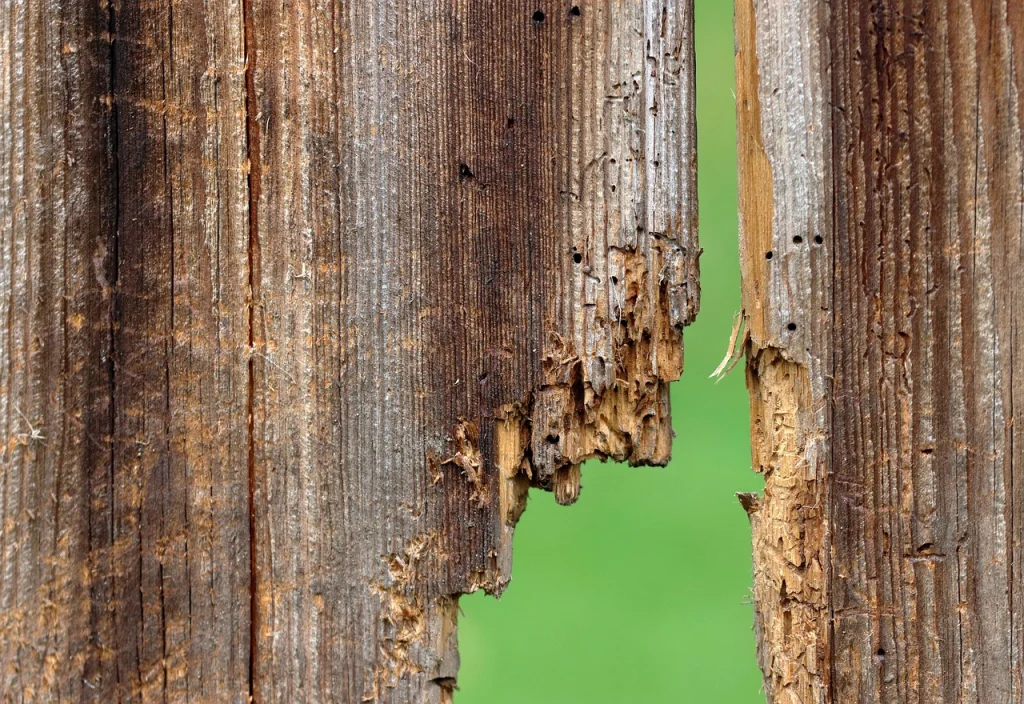
That only works if the posts will last as long as the new boards. Ask the contractor to check each post at ground level, and to replace any that move or are soft. If several posts are failing, a full replacement is usually the better use of the money. On a fence built before 2004, the old wood may be treated with chromated arsenicals (CCA): the EPA says manufacturers stopped making CCA wood for homeowner uses in December 2003. The EPA advises against burning any preservative-treated wood at home, and says it can usually go out with ordinary trash, though state and local rules may differ.
Permits, property lines and digging
- Utility lines. 811 is “the free national before-you-dig service”, and its site says to contact it a few business days before any digging, fences included. Utilities then mark the approximate location of their buried lines with paint or flags. Ask your contractor who makes the request.
- Permits and rules. Whether a fence needs a permit, how tall it may be and how far it must sit from the line are set locally, and a homeowners’ association may add its own rules. Your local building or zoning office decides; ask before ordering materials. HomeGuide puts a fence permit at $40 to $150 (February 2026); HomeAdvisor says $20 to $60 (June 2026).
- Pool fences. If the fence is part of a pool barrier, local code sets the requirements. CPSC’s pool barrier guidelines, which it says are not mandatory, recommend a barrier at least 48 inches high and self-closing, self-latching gates.
- Posts in the ground. The posts we priced are sold as rated for ground contact, and the rails as above ground. Ask that every post set in soil or concrete carries a ground-contact rating.
Digging is part of other outside jobs too; our French drain cost guide covers trenching work priced by the foot.
What a fence quote should list
- Total length and layout, measured on site, with the number and width of gates.
- Materials by name: wood species and treatment, picket size, rail count, post size and rating, or the vinyl panel and post model.
- Posts: spacing, hole depth and diameter, and concrete or gravel. Quikrete’s data sheet, for example, suggests a hole about three times the post’s width and a third of the post’s length deep.
- Tear-out and disposal: whether old posts and footings are removed, and who pays dump fees.
- Permit and utility marking: who applies, who pays, and who requests the 811 marking.
- Property line: who decides where the fence goes, and whether a survey is needed.
- Gates and hardware: hinges, latches and gate posts.
- Warranty on labor and materials, in writing, and the payment schedule.
Watch for a single price with no length or materials named, a large payment before materials arrive, or a crew that plans to dig before utility lines have been marked. When you compare quotes, make sure they cover the same length, height and gates; the calculator lets you rebuild each one line by line. Similar by-the-foot outside jobs work the same way, from siding replacement to an asphalt driveway.
What the calculator leaves out
- Ground conditions. Rock, roots, slopes and buried old footings can add hours we can’t see. Raise the hours if your yard is difficult.
- Equipment and delivery are treated as part of overhead, not as separate lines. A small job may carry a minimum charge on top.
- Staining or sealing, retaining walls, grading and tree work.
- Price changes. Lumber and vinyl prices move, and the store prices here are one store’s online prices on one day. Enter your own.
- Chain link and ornamental metal are priced only from a materials figure you enter.
General information, not professional, legal or financial advice. Cost figures are published estimates and worked examples, not quotes, and local prices vary. A licensed local contractor and your local permit office decide what your fence needs. CostPlain does no fence work and takes no referral fees.
Sources checked on 3 November 2026.
Formulas and sources
- Fence sections: Homewyse: posts set at 8 ft spacing (May 2026)
- Posts: Homewyse: posts set at 8 ft spacing (May 2026)
- Pickets: Arithmetic on the reader's entries; method on our how-we-estimate page
- Wood materials before concrete: Lowe's online prices, 3 Nov 2026: 4x4x8 ground-contact post
- Vinyl materials before concrete: Arithmetic on the reader's entries; method on our how-we-estimate page
- Other materials before concrete: Arithmetic on the reader's entries; method on our how-we-estimate page
- Concrete bags: Quikrete Fast-Setting Concrete Mix No. 1004 data sheet
- Concrete cost: Quikrete Fast-Setting Concrete Mix No. 1004 data sheet
- Materials before waste and tax: Arithmetic on the reader's entries; method on our how-we-estimate page
- Materials with waste and tax: Arithmetic on the reader's entries; method on our how-we-estimate page
- Install labor hours per 100 ft used: Our assumption, checked against HomeGuide (Feb 2026)
- Install labor hours: Arithmetic on the reader's entries; method on our how-we-estimate page
- Tear-out labor hours: Arithmetic on the reader's entries; method on our how-we-estimate page
- Total labor hours: Arithmetic on the reader's entries; method on our how-we-estimate page
- Wage with employer costs: BLS ECEC June 2026, construction: $51.96 total compensation per $36.13 wages
- Labor cost: BLS OEWS May 2025: fence erectors (47-4031) median hourly wage
- Materials, labor and disposal: Arithmetic on the reader's entries; method on our how-we-estimate page
- Overhead and profit: FEMA NFIP Bulletin W-13064: 10% overhead plus 10% profit (2013)
- Gates: Arithmetic on the reader's entries; method on our how-we-estimate page
- Estimated total: Arithmetic on the reader's entries; method on our how-we-estimate page
- Estimated cost per foot: Arithmetic on the reader's entries; method on our how-we-estimate page
- Employer cost per dollar of wages, construction (1.44, as of 2026-11-03): BLS Employer Costs for Employee Compensation, June 2026, construction (Table 4)
- Install labor hours per 100 ft, wood privacy (our assumption) (16, as of 2026-11-03): Our assumption, at the top of HomeGuide's 13 to 16 hours per 100 ft for picket or privacy fences (Feb 2026)
- Install labor hours per 100 ft, vinyl panels (our assumption) (12, as of 2026-11-03): Our assumption: panels slide into posts instead of boards being fixed one by one; HomeGuide gives 13 to 16 hours for privacy fences (Feb 2026)
- Install labor hours per 100 ft, other fences (our assumption) (12, as of 2026-11-03): Our assumption; HomeGuide gives 6 to 10 hours per 100 ft for chain link and 13 to 16 for privacy fences (Feb 2026)
Sources
- HomeGuide: Fence installation cost (3 February 2026, lead-generation site)
- HomeAdvisor: How much does it cost to install a fence? (updated 20 June 2026, lead-generation site)
- Homewyse: Cost to install a wood privacy fence (May 2026, commercial estimator)
- Homewyse: Cost to install a vinyl fence (May 2026, commercial estimator)
- Homewyse: Cost to install a chain link fence (May 2026, commercial estimator)
- Inch Calculator: Cost to install a fence (page dated 7 July 2023, titled 2026 prices)
- Ergeon: Wood fence costs (updated 1 July 2026, fence installer)
- BLS Occupational Employment and Wage Statistics, May 2025: fence erectors (47-4031)
- BLS Employer Costs for Employee Compensation, June 2026, Table 4
- FEMA NFIP Bulletin W-13064: Allowance for Overhead and Profit (2013)
- Quikrete Fast-Setting Concrete Mix (No. 1004) data sheet
- Lowe's: 4x4x8 ground-contact pressure-treated post (seen 3 November 2026)
- Lowe's: 2x4x8 pressure-treated board (seen 3 November 2026)
- Lowe's: 6 ft dog-ear pressure-treated fence pickets, search results (seen 3 November 2026)
- Lowe's: 6 ft x 8 ft white vinyl privacy fence panels, search results (seen 3 November 2026)
- 811: the national before-you-dig service (Common Ground Alliance)
- CPSC Publication 362: Safety Barrier Guidelines for Residential Pools
- EPA: Chromated Arsenicals (CCA), last updated 22 December 2025
- Lowe's: 50 lb fast-setting concrete mix, search results (seen 3 November 2026)
- Lowe's: 5 in x 5 in white vinyl fence line post, search results (seen 3 November 2026)
- Lowe's: galvanized chain link fence fabric, 50 ft rolls, search results (seen 3 November 2026)
- Menards: 6 ft dog-ear pressure-treated and cedar fence pickets, search results (seen 3 November 2026)